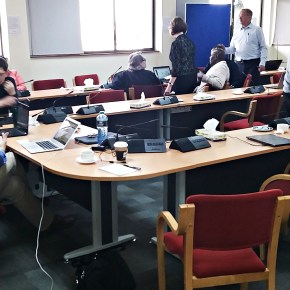
A senior delegation from the International Livestock Research Institute (ILRI) is supporting and engaging in this week’s (2830 Nov 2018) global conference on ‘Accelerating the End of Hunger and Malnutrition’, in Bangkok. Continue reading
Category Archives: Advocacy
Ten questions and answers about ILRI’s Kapiti Research Station
This brief Q&A is intended to set the record straight about what ILRI is, what we’re doing at Kapiti, and what makes our title to the land there so secure. Continue reading
Call to improve food safety in low- and middle-income countries—From hazards to risks and from farm to fork
A new report strengthens the economic case for increased public investment and other policy attention on food safety in developing countries. It synthesizes evidence of the economic costs of unsafe food in relation to both domestic markets and trade, positions food safety as an integral part of economic development and food system modernization, and provides guidance on improving food safety awareness and behaviour from farm to fork. Continue reading
Enhancing global livestock advocacy for sustainable development
Global Livestock Advocacy for Development (GLAD) has been a two-year project whose main objective has been to raise investor interest in livestock-related research-for-development issues. It has done this largely by distilling and presenting evidence and creative content about smallholder livestock systems and their critical roles in sustainable food systems and development. Continue reading
ILRI corporate report 2016–2017 now available: Investing in sustainable development
Rising demand for milk, meat and eggs in developing countries is opening up big new opportunities to establish and grow businesses and create jobs. While rapidly changing livestock systems pose a range of environmental, health and equity challenges across the highly heterogeneous livestock production systems worldwide, targeted investment in sustainable livestock research for development can produce more food, increase resilience in communities and the environment, and drive equitable and broad-based economic growth. Helping to ensure that hundreds of millions of poor small-scale livestock farmers, processors and marketers, many of whom are women, benefit from these opportunities will be crucial to achieving many of United Nations Sustainable Development Goals (SDGs). Continue reading
Livestock-enhanced diets in the first 1,000 days of life: Pathways to better futures in low-income countries
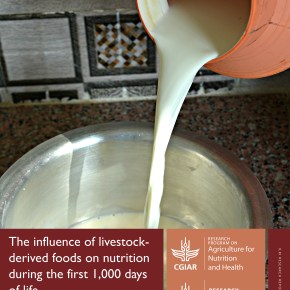
A new report was published this month on the value of ensuring consumption of meat, milk and eggs by infants up to two years of age and by expectant and new mothers in developing countries (the first 1,000 days). The report was published by ILRI and the Chatham House Centre on Global Health Security. Highlights of the findings of this joint ILRI-Chatham livestock study were presented at a side event at the EAT Stockholm Food Forum on 11 Jun 2018. Continue reading
Can livestock-enhanced diets of the poor in the first 1,000 days of life lead to healthy and sustainable futures?
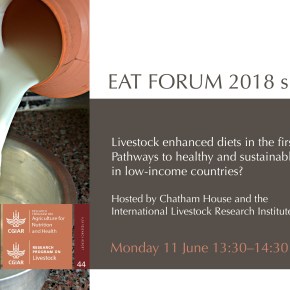
This year’s EAT 2018 Stockholm Food Forum (11–12 Jun 2018) explores ways to achieve healthy and sustainable diets for a growing global population. On Monday, 11 Jun 2018, Chatham House and ILRI will host a side event around the findings of an evidence review on the influence of livestock-derived foods—meat, milk and eggs—on the nutrition of women and of children during their first 1,000 days of life, from conception to age two. Continue reading
Why milk, meat and eggs can make a big difference to the world’s most nutritionally vulnerable people
Opinion piece by ILRI scientist Silvia Alonso on the ILRI-Chatham House report on the importance of livestock-derived foods in the first 1,000 days of life. Continue reading
Meat, milk, eggs can make a big difference in the first 1,000 days of life in low-income countries—New report
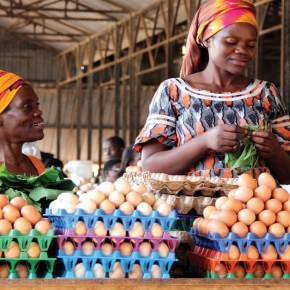
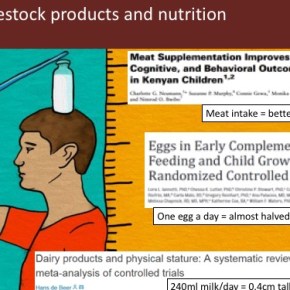
An extensive review of research found demonstrable nutritional benefits of providing children, particularly in countries in Africa and South Asia where undernutrition is highest, with livestock-derived foods such as meat, milk and eggs. Consumption of livestock-derived foods was typically found to be very low among poor families in those countries. The influence of livestock-derived foods on nutrition during the first 1,000 days of life, published by the International Livestock Research Institute (ILRI) and Chatham House, also concluded that it was possible to meet the nutritional needs of the most vulnerable through livestock-derived produce even if total global livestock production slowed down. Continue reading
Livestock are taking the limelight in global policymaking fora
Recognition of the importance of livestock in addressing some of the world’s greatest challenges, including meeting the United Nations’ 17 Sustainable Development Goals, has been rising sharply in recent years among leading national, political, donor and international bodies. Continue reading