New map: Impacts of climate change on length of growing periods in Africa
Africa / Agriculture / Books and Chapters / CCAFS / Climate Change / Geodata / ILRI / ILRIComms / Knowledge and Information / SLS / Spotlight

New map: Impacts of climate change on length of growing periods in Africa

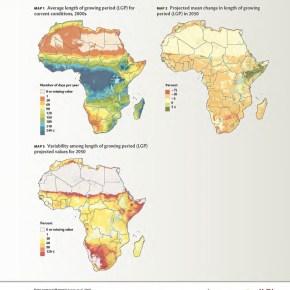
Impacts of climate change on length of growing periods in Africa by Philip Thornton The International Food Policy Research Institute (IFPRI) has published an atlas illustrating the current state of African smallholder agriculture. The Atlas of African Agriculture Research and Development comprises a series of maps and short analyses that showcase and locate the continent’s diverse agricultural … Continue reading
New map: Rainfall and rainfall variability in Africa
Africa / Agriculture / Books and Chapters / CCAFS / Geodata / ILRI / ILRIComms / Knowledge and Information / SLS / Spotlight / Water

New map: Rainfall and rainfall variability in Africa

An average of less than 1,000 millimeters of rain falls per year across most of Africa (Map 1). Rainfall tends to decrease with distance from the equator and is negligible in the Sahara (north of about latitude 16°N), in eastern Somalia, and in the southwest of the continent in Namibia and South Africa. Rainfall is most abundant on the eastern seaboard of Madagascar; portions of the highlands in eastern Africa; large areas of the Congo Basin and central Africa; and parts of coastal western Africa including Liberia, Sierra Leone, and Guinea. Continue reading

New map: Ruminant livestock distribution in Africa
Africa / Agriculture / Books and Chapters / Geodata / ILRI / ILRIComms / Knowledge and Information / Livestock / Livestock Systems / SLS / Spotlight

New map: Ruminant livestock distribution in Africa

Ruminant livestock are raised across large parts of Africa where environmental conditions allow. Cattle, sheep, and goats are the most widespread, while camels are restricted to drier areas, particularly in the Horn of Africa and the arid parts of western Africa. These maps of ruminant dis­tribution should, however, be used in conjunction with the livestock production systems map to better under­stand the systems and climate zones where ruminant live­stock are found. The role of livestock varies greatly depending on the production system. Continue reading

New map: Livestock and mixed crop-livestock systems in Africa
Africa / Agriculture / Books and Chapters / CCAFS / Crop-Livestock / Geodata / ILRI / ILRIComms / Knowledge and Information / Livestock Systems / SLS / Spotlight

New map: Livestock and mixed crop-livestock systems in Africa

Livestock-producing agricultural systems cover 73 percent of Africa and stretch across several climates (Map 1). To some extent, these climates determine what type of farming is practiced. In Africa, livestock-producing systems are broken into two main categories: livestock and mixed crop-livestock. These systems exist in three common African climates: arid/semiarid, humid/subhumid, and temperate/tropical highlands. Continue reading

Realpolitik–Nairobi ‘Community of Practice’ communicators get real practice impacting policymakers
Agriculture / CapDev / East Africa / Environment / ILRI / ILRIComms / Kenya / Knowledge and Information / Policy / Spotlight

Realpolitik–Nairobi ‘Community of Practice’ communicators get real practice impacting policymakers

A community of practice for communications staff in research and development organizations (DevComms CoP) based in Nairobi participated in a ‘Science Communications for Policy Impact’ workshop following a conference, ‘Landscapes for People, Food and Nature’, at ICRAF on 3 July 2014. Continue reading

New maps for navigating a sea of changes in livestock production
A4NH / Article / CCAFS / Geodata / HUMIDTROPICS / ILRI / Knowledge and Information / Livestock / Livestock Systems / SLS / Spotlight

New maps for navigating a sea of changes in livestock production

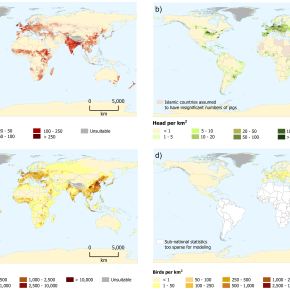
A collaborative effort by some of the world’s leading agriculture experts has produced a new set of maps published today in the journal PLoS ONE that provides the most detailed rendition ever produced of the billions of cattle, pigs, poultry and other livestock living in the world today. Continue reading