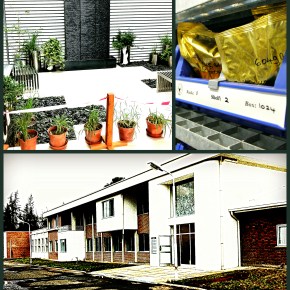
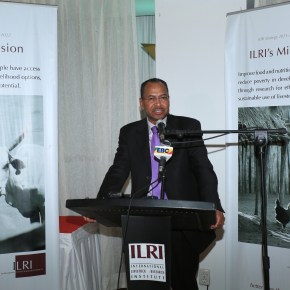
With the opening of the latest high-tech forage genebank and bioscience research facilities, the International Livestock Research Institute (ILRI) in Ethiopia is well on the way to realizing it dream of becoming a major science hub in eastern Africa. Speaking at the beginning of the launch of the new facilities yesterday, Siboniso Moyo, representative in Ethiopia for the ILRI director general, spoke of the new facilities as the beginning of a drive to upscale facilities on the campus. Continue reading
Category Archives: Biodiversity
ILRI opens state-of-the-art genebank and bioscience facilities in Ethiopia
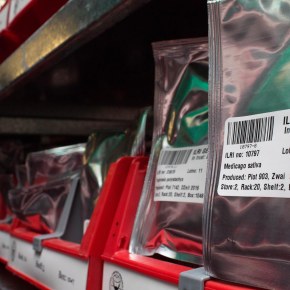
The International Livestock Research Institute (ILRI) officially opens state-of-the-art facilities for genebank and bioscience research on 24 April 2017. The facilities will help protect a crucial component of the planet’s biodiversity—the diverse grasses and legumes that feed the world’s food animals. Research conducted here on livestock feed materials improves the sustainability and productivity of the livestock sector in many low-income countries across the world. Continue reading
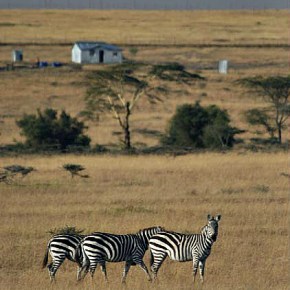
Fragmentation of the Athi-Kaputiei plains, outside Nairobi, has caused rapid declines in both pastoralism and wildlife
A new paper on the consequences of land fragmentation and fencing on rangelands outside Nairobi, Kenya, formerly rich with wildlife and critical for the functioning of Nairobi’s famed national park, has been published. All of the authors are former staff, and one former partner, of the International Livestock Research Institute (ILRI), where this research work was conducted. Continue reading
Kenya’s wildlife populations are in ‘widespread’ and ‘catastrophic’ decline—New study
Here’s a wake up call for all those who care about Kenya’s rich heritage of wild animals, rangelands and pastoral peoples. A new study reporting on the period from 1977 to 2016 says wildlife on the rangelands of Kenya, which still support some of the richest herds of mammals on earth, is in precipitous decline while populations of goats and sheep are increasingly sharply. Continue reading
Badass Chinese sheep quickly evolved adaptations to extreme plateau and desert environments—New study
A new study offers novel insights into rapid genomic adaptations to extreme environments in sheep and other animals and provides a valuable resource for future research on livestock breeding in response to climate change. Continue reading
Protecting crop and feed diversity enhances food security while reducing greenhouse gases
Crop diversity can be conserved and shared. Scientists know how to do it and at a very limited cost to the world community. It requires global leadership and stronger partnerships and the building of capacities of scientists in the developing world. No country is self-sufficient; successful breeding is highly dependent on functioning multilateralism, according to Marie Haga, executive director of the Global Crop Diversity Trust. Continue reading
Celebrating Ethiopia’s biodiversity: high-level seminar at ILRI on 23 February
Ethiopia has long been recognised as a biodiversity hotspot, one of the eight centres of global crop diversity. Barley, coffee, sorghum and some wild types of wheat all originated in these fertile lands. Recognizing the importance of this diversity to guaranteeing global food security, the Ethiopian Biodiversity Institute, the Global Crop Diversity Trust and the International Livestock Research Institute hold a high-level seminar on 23 Feb 2016 at 6 pm. Continue reading
Climate-smart livestock farming in developing countries is boosted by a £10-million research award
Researchers at the Roslin Institute will be using funds from the Bill & Melinda Gates Foundation to investigate how genetic information can improve the health and productivity of farmed animals in tropical climates, which is a proven approach to climate change mitigation and adaptation. The Centre for Tropical Livestock Genetics and Health is an alliance between the Institute at the University of Edinburgh, Scotland’s Rural College (SRUC) and the Africa-headquartered International Livestock Research Institute (ILRI). The partner institutions are making additional contributions with a value of £10 million to support the initiative over the next five years. Continue reading
Why communicate agricultural science to non-specialists? A brief for livestock geneticists
At a recent workshop co-hosted by an NGO called Biosciences for Farming in Africa (B4FA) and the International Livestock Research Institute (ILRI), in Nairobi, Kenya, ILRI communications staff Susan MacMillan made a short presentation on why the 20-plus animal geneticists in the room should bother communicating their science to non-specialists. The big picture ‘A … Continue reading
Bridging ‘biobanking’ and biomedical research across Europe and Africa: ‘B3Africa’ launched in Cape Town
The first meeting of a new project, ‘B3Africa, short for ‘Bridging Biobanking and Biomedical Research across Europe and Africa’, was held this week (24–25 Aug 2015) at the University of the Western Cape, in Cape Town, South Africa. Continue reading