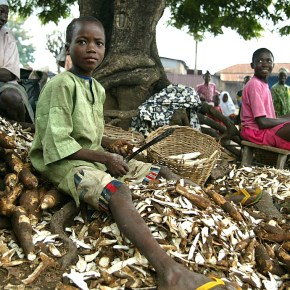
With livestock production expected to more than double in the next 40 years, transforming cassava peels into high quality feed holds huge potential for African economies struggling to meet rapidly rising demand for animal-source products, according to research proposal recently published by three CGIAR centres. Continue reading
Category Archives: PIL
Policies, Institutons and Livelihoods program
All flesh is grass (except in Nigeria, where it might be cassava peel)
Scientists are developing a way of transforming the mountains of cassava peels created every day in Nigeria, where cassava is a staple food, into a nourishing feed for smallholder farm animals. The several CGIAR centres involved include the International Livestock Research Institute (ILRI), the International Institute for Tropical Agriculture (IITA) and the International Potato Center (CIP). Also involved in this project are several CGIAR research programs—Livestock and Fish; Integrated Systems for the Humidtropics; and Roots, Tubers and Bananas—as well as the Global Cassava Partnership for the 21st Century (GCP21). Continue reading
From food waste to animal feed, cassava peels potentially big business for Nigerian women
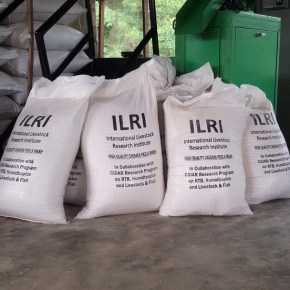
Existing technologies of drying and grading cassava peels could hold the key to providing a readily available and sustainable source of animal feeds, increasing incomes for women and boosting food security in West Africa. Continue reading
A look at multi-stakeholder (aka innovation) platforms: From Africa RISING to MilkIT to imGoats to Humidtropics
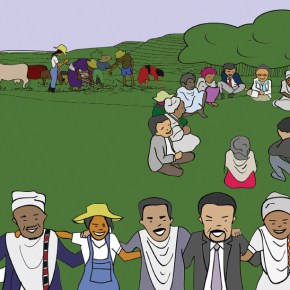
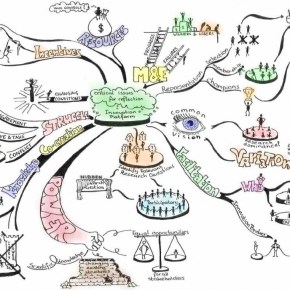
Multi-stakeholder or innovation platforms are increasingly seen as a promising vehicle for agricultural innovation and development. In the field of agricultural research for development (AR4D), such platforms are an important element of a commitment to more structural and long-term engagement between stakeholders in the agricultural sector. Continue reading
CGIAR Innovation Platform Case Study Competition: And the winner is . . .
In Nov 2014, to better assess the efficiency of these innovation platforms and to document their successes and challenges in different developing countries, Humidtropics launched an Innovation Platforms Case Study Competition. In Feb 2015, twelve candidates were selected to participate in a writeshop focused on writing strong, reflective and cohesive case studies. Earlier this month (Jun 2015), jury members in an editors’ meeting reviewed all the final submissions and chose eight cases to be featured in a Humidtropics Anthology to be published by an academic publisher before the end of 2015; the jury also recommended that two cases be published separately. Continue reading
Small farmers and big retailing: What works? What doesn’t? in developing countries
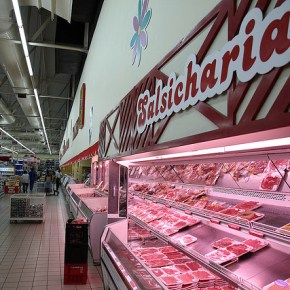
What, or who, is a smallholder farmer? What is the ongoing retail revolution in developing countries all about? Are small-scale farmers involved? Two agricultural economists, Derek Baker, formerly of ILRI and now at the University of New England (UNE), in Australia, and Jo Cadilhon, of ILRI, help us think this through in a presentation they made at the GLOBALG.A.P. Summit in Abu Dhabi this week. Continue reading
CTA-ILRI African dairy value chain seminar closes with colourful results
The International Livestock Research Institute (ILRI) and the Technical Centre for Agriculture and Rural Cooperation ACP-EU (CTA) organized the CTA-ILRI African dairy value chain seminar from 21 to 24 September 2014 in Nairobi, Kenya. Continue reading
Accessing finance for livestock and dairy value chains in developing countries: Recommendations
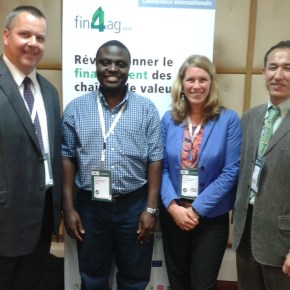
This week (15 Jul 2014), the International Livestock Research Institute (ILRI) organized a discussion at CTA’s Fin4Ag Conference in Nairobi on ‘Testing innovations in livestock and dairy value chain finance: Insights from East and Southern Africa’. The discussion was moderated by Jo Cadilhon, a senior agro-economist in ILRI’s Policy, Trade and Value Chains Program who is based at the institute’s Nairobi headquarters. Continue reading
Tanzanian dairy film: The workings of a successful dairy platform
This 5-minute film tells the story of the Tanzanian Tanga Dairy Platform, which is helping dairy farmers in Tanzania to improve their milk production and sales. Continue reading
African talent feeding African markets with African products: Global food and agribusiness meeting hears of ‘livestock value chains’ in Africa
In Jun 2014 three agricultural economists working with the International Livestock Research Institute presented case studies at the World Forum of the International Food and Agribusiness Management Association (IFAMA) in Cape Town, South Africa. The main lesson from the two cases presented is that by training farmers, processors and other stakeholders supporting agribusiness development, African talent can create new products and innovative processes that help feed African markets with African products. Continue reading