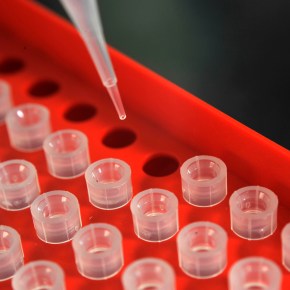
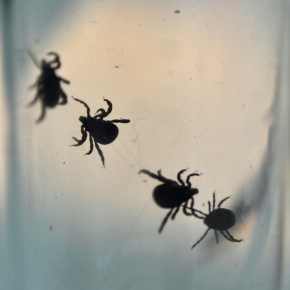
ILRI’s Tick Unit has been selected as Africa’s first outpost for the Tick Cell Biobank. The parent Tick Cell Biobank at the Institute of Infection and Global Health, University of Liverpool, houses a collection of approximately 55 cell lines derived from argasid and ixodid ticks, which are of both veterinary and medical importance. Funded by the UK Biotechnology and Biological Sciences Research Council (BBSRC) Global Challenges Research Fund, the Biobank Outpost project will facilitate access of the tick cell lines by researchers in low- and middle- income countries in Africa, South East Asia and South America. The countries selected for the Outposts include Kenya, Malaysia and Brazil. Continue reading
Category Archives: AHH
Animal and Human Health program
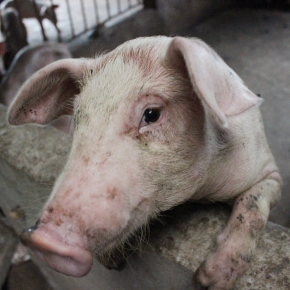
African swine fever ten years on: the lessons learned and the way forward
An interview with Dirk Pfeiffer, François Roger, Linda Dixon and Dieter Schillinger to better understand existing knowledge gaps between research findings managing the spread of African swine fever and actionable solutions. Continue reading
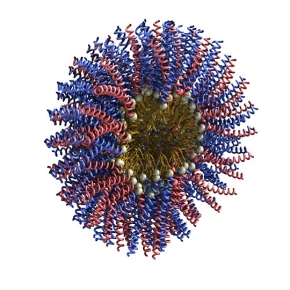
ILRI scientists are applying advanced ‘nanovaccinology’ in development of new vaccines against devastating tropical livestock diseases
Smaller than 100 nanometres in diameter—about 60 times smaller than the width of human hair and comparable in size to microscopic structures within cells—synthetically produced nanoparticles are readily incorporated into biological systems. These ‘ultrafine particles’, which can be produced using several methods, are of increasing scientific interest. Very stable and harmless to plants and … Continue reading
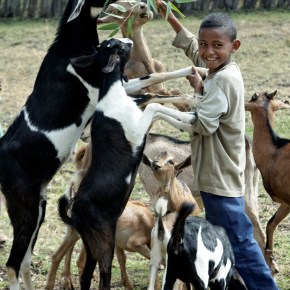
Animal health experts on the ‘goat plague’ known as PPR chart ways forward for better controlling a widespread disease harming the world’s small-scale sheep and goats producers
Peste des petits ruminants (PPR), also known as ‘goat plague’, is a viral disease related to rinderpest of sheep as well as goats. This contagious transboundary disease hurts the livelihoods of millions of small-scale livestock farmers, threatening food security with estimated economic losses exceeding USD1.5 billion per year. The disease threatens 80 per cent of … Continue reading
Antimicrobial Resistance through the eyes of the journalists in Kenya
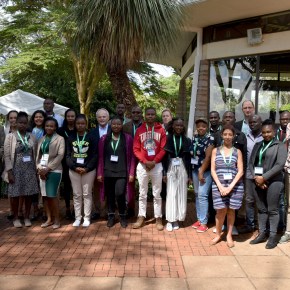
In the lead up to the World Antibiotic Awareness Week 2019 (#WAAW2019), which is celebrated every year in November, the CGIAR AMR Hub at the International Livestock research Institute (ILRI) jointly with Kenya’s ministries of Health and Agriculture, Livestock, Fisheries and Irrigation hosted, at the ILRI campus in Nairobi, a media sensitization on raising antimicrobial resistance (AMR) … Continue reading
More vaccination, not antibiotics, needed for Kenyan livestock—Straight talk by Sidai Chair Christie Peacock
An interview with Christie Peacock, founder and chairman of Sidai Africa, Ltd., a Kenyan company that provides livestock services and crop inputs to farmers across the whole of Kenya. Continue reading
ONE HEALTH FOR AFRICA: Germany’s BMZ initiates a new ‘One Health Research, Education and Outreach Centre for Africa’
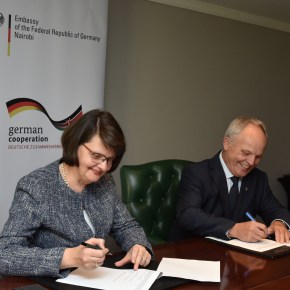
Today, the German Federal Ministry for Economic Cooperation and Development (BMZ) and ILRI signed a letter of intent to establish a ‘One Health Research, Education and Outreach Centre for Africa’ (OHRECA) to be hosted by ILRI, which is headquartered in Nairobi, Kenya. Continue reading
OneHealthDay is this Sunday: Join ILRI in collaborative work for healthier people, animals and lands
ILRI researchers have been investigating diseases that afflict both people and animals in an ecosystem context for more than 40 years. ILRI’s animal health and environmental scientists have found One Health approaches to highly useful in their work. Continue reading
World Bank report says ‘AMR-smart’ solutions needed to beat superbugs and ensure a healthier future
The report urges the development community to
go beyond technical solutions that focus exclusively on the
misuse of antimicrobials. We need to redirect development
efforts more broadly, so that they become ‘AMR-smart.’ Continue reading
Confused about the meat/milk/diet wars? That’s OK. It’s complicated. And poorly fact-checked. And under-studied.
Just in time to add fuel to the fire of the current meat, milk and diet wars being waged in scholarly and lay media alike comes the latest issue (Oct 2019) of the scientific journal ‘Animal Frontiers’ on ‘Foods of animal origin: A prescription for global health’, with the term ‘health’, here, covering both human and environmental health. What it offers is a clear-headed, evidenced based, balanced look at the facts as we know them, and the facts that we need. Continue reading