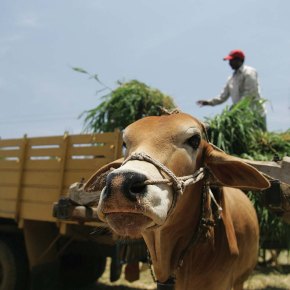
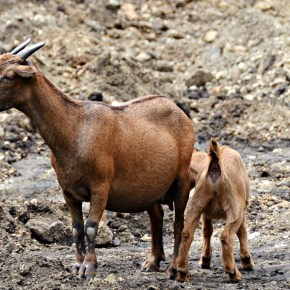
An article in ‘Animal’ compares the lifetime performance (mortality, maturity, nutrition, birth weight etc.) of West African Dwarf goats kept under various feeding systems. Continue reading
Category Archives: SLS
Sustainable Livestock Systems program
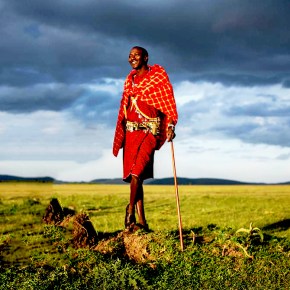
Livestock-wildlife trade-offs for pastoral livelihoods in the conservancies of the Masai Mara
A new research paper, Trade-offs for climate-resilient pastoral livelihoods in wildlife conservancies in the Mara ecosystem, Kenya, was recently published in Pastoralism: Research, Policy and Practice, May 2017. The paper is co-authored by Claire Bedelian, of the International Livestock Research Institute (ILRI), Overseas Development Institute (ODI), and University College London (UCL), and Joseph Ogutu, of ILRI and the University of Hohenheim. Continue reading
ILRI’s Index-Based Livestock Insurance and Takaful Insurance of Africa win ‘2017 Insurance Innovation Award’
ILRI’s Index Based Livestock Insurance (IBLI) program and Takaful Insurance of Africa are this year’s winners of the prestigious Insurance Innovations Award 2017. The announcement was made at the African Reinsurance Corporation (Africa Re)’s Insurance Awards gala dinner held on Monday 22 May 2017, at the Serena Kigo Hotel, in Kampala, Uganda. Continue reading
Research to help secure rangelands for users presented at World Bank Land and Poverty Conference
Together with its partners, the International Livestock Research Institute (ILRI) has now taken its research agenda on adaptation and resilience a notch higher, at the on-going Annual World Bank Conference on Land and Poverty themed ‘Responsible Land Governance—Towards an Evidence-Based Approach’. ILRI is one of the major partners that have supported this premier global forum on land governance. Continue reading
The legacy of Norman Borlaug: Alive and well at the International Livestock Research Institute
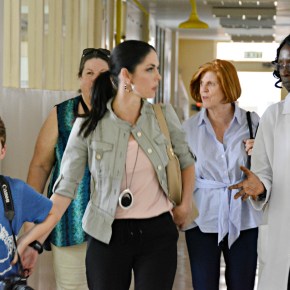
ILRI was honoured by a visit this week to ILRI by Julie Borlaug (left) and Jeannie Borlaug Laube, granddaugher and daughter of Norman Borlaug, respectively. Continue reading
CGIAR livestock support is enhancing community resilience in the face of on-going drought in the Horn of Africa
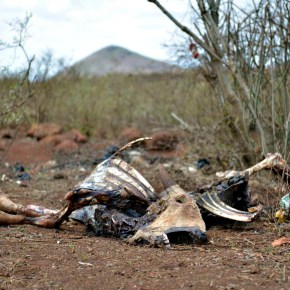
Widespread drought conditions in the Horn of Africa have intensified since the failure of the Oct–Dec 2016 rains. Areas of greatest concern cover much of Somalia, northeast and coastal Kenya, southeast Ethiopia and the Afar region, and South Sudan, which faces a serious food crisis due to protracted insecurity. One focus of the East African-headquartered International Livestock Research Institute (ILRI) is to help developing-country livestock communities enhance their resilience in the face of recurring droughts. ILRI belongs to CGIAR—a global research partnership of 15 centres and their partners working yo reduce poverty, enhance food and nutrition security and improve natural resources and ecosystem services. Continue reading
Record payouts being made by Kenya Government and insurers to protect herders facing historic drought
More than Ksh214 million is on tap for 12,000 pastoral households in six counties of northern Kenya through innovative policies that use satellite imagery to trigger payments for feed, veterinary supplies and water. Continue reading
Sustainable livestock systems – highlights from ILRI’s corporate report 2015–2016
In 2015–2016, the International Livestock Research Institute (ILRI) and partners revealed extraordinary findings that the greenhouse gas (GHG) emissions from cattle in Kenya maybe up to 10 times lower than previous estimates, clearly making the case for improving Africa-specific understanding of GHG emissions to develop better-targeted climate change mitigation and adaption strategies. Continue reading
Confronting the rising threat of antibiotic resistance in livestock
The article, originally published on Cambridge Core blog, was written by Tim Robinson of the International Livestock Research Institute (ILRI). Resistance to antimicrobials is developing faster than ever before due to decades of abusing these important drugs. A ‘post-antibiotic’ world looms as a result, the consequences of which would be many people and farm animals sickening and dying of what, until now, have been preventable or treatable infections. Continue reading
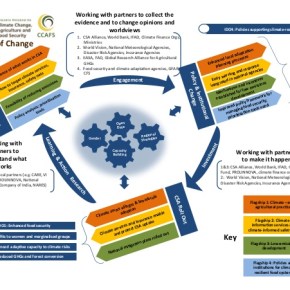
A ‘theory of change’ for agricultural research for development
The following are highlights of a new CGIAR paper advancing ways to make agricultural science make a bigger difference to development outcomes. We describe a theory-of-change approach to an agricultural research for development program. Continue reading