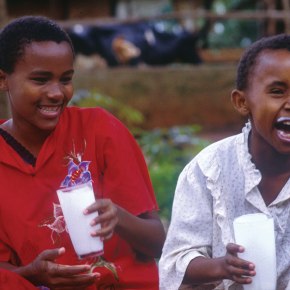
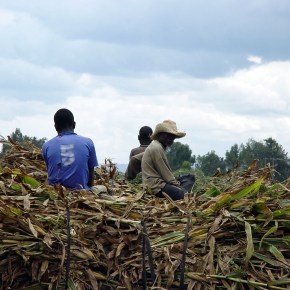
A commentary published in The Lancet last month supporting a series of five papers on antimicrobials recommends prohibiting use of antibiotics critically important for human medicine to promote the growth of livestock or to prevent routine livestock disease. The commentary was written by Tim Robinson, a principal scientist in spatial analysis at the International Livestock Research Institute (ILRI), and colleagues in partner organizations. Continue reading
Category Archives: Policy
Fragments d’ILRI: Le plan directeur pour l’élevage en Ethiopie devrait aider 2.36 millions de ménages à sortir de la pauvreté
Depuis 20 ans, le gouvernement éthiopien compte sur une réelle transformation du secteur agricole, mais l’absence d’un plan directeur en a retardé la mise en œuvre. Cependant un nouveau projet de recherche interdisciplinaire, que Barry Shapiro – chercheur à l’Institut International pour la Recherche sur l’Elevage (ILRI) – a présenté au Ministère de l’Agriculture (MdA) à Addis Abeba, révèle les bénéfices potentiels d’un Plan Directeur pour l’Elevage (PDE, LMP en anglais) en Ethiopie. Continue reading
New Kenya value chains program to lift 300,000 plus households out of poverty
Starting in October 2015, ILRI, in partnership with two other CGIAR centres, has initiated a new three-year USD25 million program to help lift 317,000 households out of poverty, making them food secure and enabling their transition from subsistence to market-orientated farming. Continue reading
A couple of ‘missings’ for the Paris climate talks
In the days leading up to the start of the climate change talks in Paris (COP21) this week (30 Nov–11 Dec 2015), we at the International Livestock Research Institute (ILRI) have been busy responding to recent articles in the press advocating that ‘the world’ eat less meat to reduce greenhouse gases and other livestock ‘bads’. … Continue reading
What’s driving Ethiopia’s fast development? Millions of smallholder farmers, of course
Industrialization is key to economic development, and agriculture—supplying raw materials for processing and value addition—is an essential component of that process. Comprising more than 40% of national GDP and producing the overwhelming majority of the Ethiopia’s food, smallholder farmers are at the centre of the country’s recent economic success. So declared the director general of the International Livestock Research Institute (ILRI), Jimmy Smith, in an agriculture panel discussion, this week, organized by the Economist magazine and held at the Sheraton Hotel in Addis Ababa. Continue reading
Unlocking the potential of Africa to scale livestock development, high-level conference
Improved livestock genetics, health and feed—guided by policies geared towards enabling a sustainable and business-friendly environment—are key to unlocking the potential of agriculture in Africa, Continue reading
Animal breeding and genetics in the Ethiopia livestock master plan
High population growth and rising living standards are putting pressure on Ethiopia’s livestock owners to increase the productivity of their animals. Improving the genetic potential of the country’s livestock is one of the keys—with better feeds and better health—to achieving food and nutrition security, and better lives through livestock. This latest research brief by ILRI and the Ministry of Agriculture (MoA), Animal breeding and genetics in the Ethiopia livestock master plan, outlines how quick-win genetic-based technologies—including artificial insemination (AI) with oestrous synchronization and community-based schemes to improve indigenous breeds as well—can significantly contribute to transformed value chains for cattle, small ruminants and poultry. Continue reading
Ethiopia livestock master plan: Livestock health priorities
Improved animal health services could hugely increase livestock productivity and the earnings of livestock keepers. As part of the Ethiopia livestock master plan, an analysis of animal health by the Livestock State Ministry (LSM) and ILRI outline the steps needed to transform the livestock sector, published as the latest ILRI brief: Livestock health priorities in the Ethiopia livestock master plan. Continue reading
Creating an enabling environment for livestock development in Ethiopia
Despite significant progress in increasing livestock production in Ethiopia, analysis of livestock production and consumption by the Livestock State Ministry (LSM) and ILRI show a huge shortfall in the supply of livestock products. Detailed interdisciplinary research provides clear empirical evidence of the potential benefits of a comprehensive livestock master plan (LMP) for Ethiopia. In the absence of investment, these gaps will grow, causing food insecurity and other important economic and social repercussions. Continue reading
Ethiopia livestock master plan: Feed priorities
Investment in livestock agriculture in Ethiopia has the potential to halve poverty, improve the food security of rural people and make livestock an increasing contributor to GDP growth. The Ethiopia livestock master plan (LMP) sets out ambitious year 2020 targets for several livestock value chains—crossbred dairy cows, red meat-milk and feedlot, and poultry. The 2020 targets aim to increase meat, milk and egg production by 58%, 83% and 828% respectively above 2012/2013 totals. Continue reading