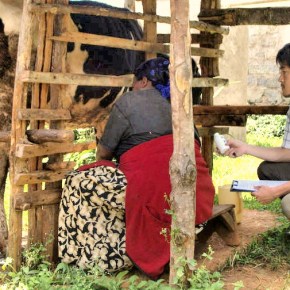
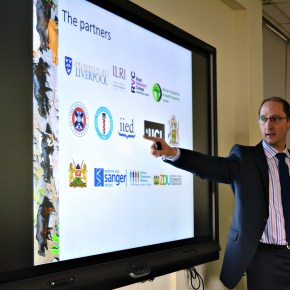
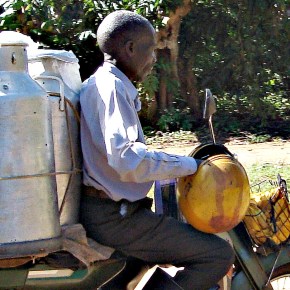
Researchers from ILRI and partners have developed and piloted an institutional innovation—a training, certification and branding scheme for informal value chain actors—with good potential to improve the safety of animal-source foods sold in informal markets. Past development policy often focused on formal markets, which at best meant neglect of informal markets and often resulted in harassment and penalties for informal agents. Continue reading
Category Archives: Agri-Health
Reducing human exposure to aflatoxins in poor countries: Towards new technologies and practices
A new paper describes and assesses the strength of a theory of change for how adoption of farm-level technologies and practices for aflatoxin mitigation can contribute to reductions in aflatoxin exposure among consumers in a market context. Continue reading
Designing practical ways to help the urban poor make choices that improve their nutrition
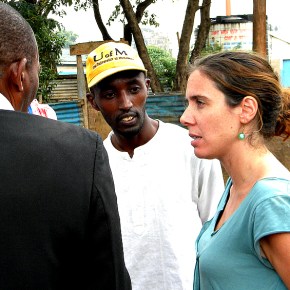
To improve interventions in food systems of the urban poor, scientists at the International Livestock Research Institute (ILRI) are investigating urban food and nutritional choices in two slums in Nairobi, Kenya. Their aim is to develop interventions that help people make food choices that improve their nutrition while staying within their low household food budgets and access. Continue reading
UK chief scientific adviser visits Kenya: Part 4—Development of a field-friendly diagnostic test for MERS
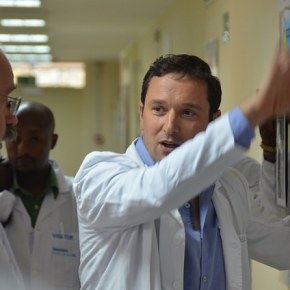
Among short presentations made to Sir Mark Walport, the UK chief scientific adviser, on his 15 Jul 2015 tour of the biosciences laboratories at the International Livestock Research Institute (ILRI), in Nairobi, Kenya, was one by Joerg Jores, a molecular biologist working to better control important livestock diseases of Africa and other developing regions. Jores is a senior scientist in ILRI’s Vaccine Biosciences program whose work supports the CGIAR Research Program on Livestock and Fish. Continue reading
UK chief scientific adviser visits Kenya: Part 3—The dual rise of the global livestock sector and antimicrobial resistance
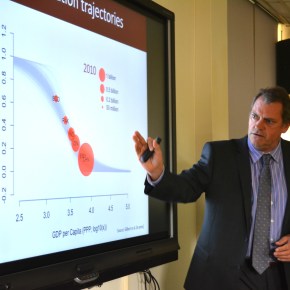
The second of two scientists to make a short presentation to Sir Mark Walport, the UK chief scientific adviser, on his 15 Jul 2015 visit to the International Livestock Research Institute (ILRI), in Nairobi, Kenya, was Tim Robinson, a livestock and spatial analysis expert. Continue reading
UK chief scientific adviser visits Kenya: Part 2—’One Health’ surveillance of infectious livestock-to-human diseases
The first scientist of two scientists to make a short presentation to Sir Mark Walport, the UK chief scientific adviser, on his 15 Jul 2015 visit to the International Livestock Research Institute (ILRI), in Nairobi, Kenya, was Eric Fèvre, a veterinary epidemiologist and joint appointee at ILRI and the Institute of Infection and Global Health at the University of Liverpool. Fèvre manages several field-oriented research projects on neglected zoonoses on behalf of the CGIAR Research Program on Agriculture for Nutrition and Health. Continue reading
UK chief scientific adviser visits Kenya: Part 1—Legacy of British-ILRI partnerships in animal health research
There has been a long-term, consistent and highly productive engagement between research institutions and funding bodies of the United Kingdom and the International Livestock Research Institute (ILRI) and its predecessors, the International Laboratory for Research on Animal Diseases (ILRAD) and the International Livestock Centre for Africa (ILCA). Continue reading
The rise of antimicrobial resistance (lethal) and animal agriculture (critical): Their links in developing countries
This Jun 2015, Evidence on Demand, an international development information hub supported by the UK Department for International Development (DFID), published a 44-page paper identifying key evidence gaps in our knowledge of livestock- and fisheries-linked antimicrobial resistance in the developing world and documenting on-going and planned research on this topic by key stakeholders.The paper, written by veterinary epidemiologist and food safety expert Delia Grace, of the International Livestock Research Institute (ILRI), is titled: Review of evidence on antimicrobial resistance and animal agriculture in developing countries. Continue reading
‘We’re having all the wrong debates’–Tamar Haspel
Award-winning journalist Tamar Haspel makes the case in her latest Washington Post column for exchanging our polarizing arguments about food issues for debates about stuff that really matters. Continue reading
It’s simple (everybody eats); It’s complicated (everybody eats differently)
The inestimable Tara Garnett, of the Food Climate Research Network, offers much new food for thought on ‘the meat question’ in a new discussion paper on What is a sustainable healthy diet? and a new think piece, Gut feelings and possible tomorrows: (where) does animal farming fit? Continue reading