A new study reveals conditions linked to the emergence and spread of deadly bird flu and maps the areas of Asia at greatest risk of the spread of the new virus strain. A dangerous strain of avian influenza, H7N9, that’s causing severe illness and deaths in China may be inhabiting a small fraction of its potential range and appears at risk of spreading to other suitable areas of India, Bangladesh, Vietnam, Indonesia and the Philippines, according to a new study published today in the journal Nature Communications. Continue reading
Category Archives: Disease Control
Assessing societal changes from changing dairy value chains in Sahelian pastoral communities
ILRI’s Jo Cadilhon introduces a method being tried out in Senegal to measure the social impacts of dairy supply chain innovation in pastoralist societies.
Continue reading
New UK funding for disease surveillance will improve health and farming in Kenya
The University of Liverpool has been given funding to start a surveillance program to reduce the incidence of diseases transmitted between people and livestock in western Kenya. The £3.6 million grant will train veterinary and medical technicians to monitor farms, markets and slaughterhouses. They will use a mobile data collection system to generate a comprehensive database of the prevalence and economic impact of these diseases. The information generated will be used to provide evidence for government health policy in the area. Continue reading
Hard numbers: Making the business case for massive investments in ‘One Health’ to protect ‘One World’
The time has come to make the bigger case for massive investment in One Health to transform the management of neglected and emerging zoonoses and to save the lives of millions of people and hundreds of millions of animals whose production supports and nourishes billions of impoverished people per annum. Continue reading
Aflatoxins in Kenya’s food chain: Overview of what researchers are doing to combat the threat to public health
Aflatoxins are toxic chemicals produced as by-products by fungi (moulds) that grow on maize, groundnuts and other food crops. These toxins also affect feedstuffs, which then contaminate milk, meat and eggs. The toxins occur everywhere in the world, but pose particularly high risks in tropical developing countries where certain staple foods, such as maize and sorghum, comprise a large part of the diets of the poor. Continue reading
Jimmy Smith on closing big livestock yield gaps in developing countries
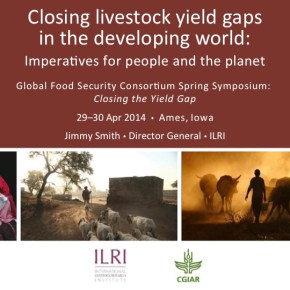
Last week, Jimmy Smith, director general of the International Livestock Research Institute (ILRI), gave a presentation on closing the big livestock yield gaps in developing countries. Smith made his presentation at the Global Food Security Consortium Spring Symposium, held in Ames, Iowa, 29–30 Apr 2014. Continue reading
Jimmy Smith on mega trends in livestock production in the world’s emerging markets: Part 2
A keynote presentation at this mega trends conference was given by Jimmy Smith, director general of the International Livestock Research Institute (ILRI), which works to relieve poverty and hunger, and to improve human and environmental health, through livestock science in developing countries. Smith spoke on the ‘Evolution of animal production in emerging markets: China, Russia, India, Brazil, Africa.’
This is the second of a two-part article. Part one is here. Continue reading
Jimmy Smith on mega trends in livestock production in the world’s emerging markets: Part 1
Last week in Florham Park, New Jersey, Zoetis, the largest animal health provider in the world, hosted a conference on Mega trends in livestock production: The state of animal agriculture 2025–2050. A keynote presentation at this mega trends conference was given by Jimmy Smith, director general of the International Livestock Research Institute (ILRI), which works to relieve poverty and hunger, and to improve human and environmental health, through livestock science in developing countries. Continue reading
Dairy feed project to reduce aflatoxin contamination in Kenya’s milk
Mycotoxins, such as aflatoxin, are toxins found in food that can cause illness and be lethal in high doses. These toxins are formed by strains of moulds that infest susceptible grains such as maize and sorghum. Dairy cows that eat contaminated feed can yield contaminated milk. Milk is a major food in Kenya. Understanding how, … Continue reading
Scientists launch multi-million dollar battle against African cattle killer
Researchers have received a grant from the Bill & Melinda Gates Foundation to develop anew-generation vaccine for East Coast fever. which could inform malaria and cancer research. Continue reading