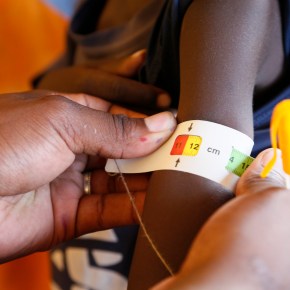
Rather than trying to replace all of the world’s meat, milk and eggs with alternatives, we should be improving husbandry systems and protecting these living assets for the most vulnerable. Continue reading
Category Archives: Human Health
Human Health
ILRI and India’s National Institute of Animal Biotechnology to identify potential areas of research collaborations in livestock genetics and animal health
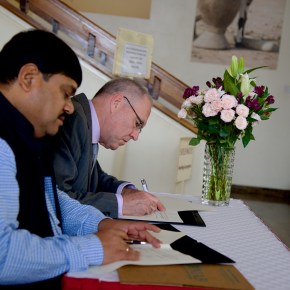
ILRI and India’s National Institute of Animal Biotechnology (NIAB) have formalized a partnership to work together in livestock genetics and animal health research programs for human and livestock development in India. Continue reading
Launching today—CGIAR Antimicrobial Resistance Hub
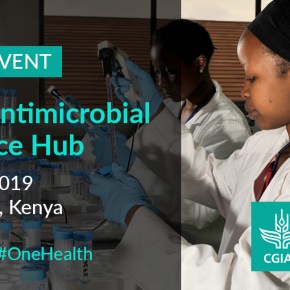
Launching today in Kenya is aCGIAR AMR Hubfor powering global, national and local partnershipsto help stem the global rise of drug-resistant pathogensthat is increasingly putting public health at risk. Continue reading
Six-million-dollar investment to tackle the causes of foodborne disease in Ethiopia
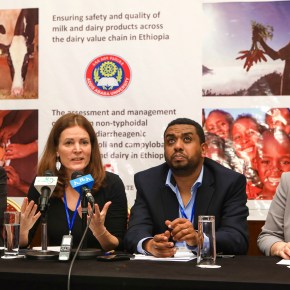
The UK Government’s Department for International Development (DFID) and the Bill & Melinda Gates Foundation (BMGF) are supporting four new research projects to address a broad set of robust and large-scale research priorities to guide program and policy efforts to improve food safety in Ethiopia. This will be achieved through a consortium of national and international research partners working together to support the country’s ongoing efforts. Continue reading
A world where livestock are part of the solution—Ethiopia state minister
The recent EAT-Lancet Commission report includes many valid points about livestock, but misses an opportunity to contextualize diverse food production systems outside rich, developed countries. This opinion piece was written by Gebregziabher Gebreyohannes, state minister in the Ethiopian Ministry of Agriculture and a board member of the International Livestock Research Institute (ILRI). Continue reading
Should we eat red meat? Depends on who’s eating—New York Times
A particularly sane, sensible and equitable news report—one that takes an uncommon global perspective about optimal meat consumption—reviews recent diet guidelines recommended by some of the world’s foremost scientists in diet-, health- and environment-related fields and published in a leading medical journal. Continue reading
A new project promises to generate better dietary and health data for agriculture and nutrition interventions in Africa
The Food, Agriculture and Natural Resources Policy Analysis Network (FANRPAN) and the International Livestock Research Institute (ILRI) are implementing a project on ‘Improving Dietary and Health Data for Decision-making in Agriculture and Nutrition Actions in Africa’ with funding from the International Development Research Centre (IDRC). Continue reading
One Health: Antibiotic resistance, zoonotic diseases and food security in focus for SIGHT Award 2018
Originally posted on ILRI Asia:
Johanna Lindahl, senior scientist in veterinary-epidemiology, is awarded the SIGHT Award 2018 and SEK 100 000 from the Swedish Institute for Global Health Transformation, SIGHT. The prize is awarded for excellent scientific contribution to global health. Lindahl is an associate professor and active at the International Livestock Research Institute, the…
Call to improve food safety in low- and middle-income countries—From hazards to risks and from farm to fork
A new report strengthens the economic case for increased public investment and other policy attention on food safety in developing countries. It synthesizes evidence of the economic costs of unsafe food in relation to both domestic markets and trade, positions food safety as an integral part of economic development and food system modernization, and provides guidance on improving food safety awareness and behaviour from farm to fork. Continue reading
New World Bank report says food-borne illnesses cost USD110 billion per year in low- and middle-income countries
Originally posted on AgHealth:
Rinsing fresh fish in Accra, Ghana (photo credit: ILRI/Kennedy Bomfeh). A new World Bank study finds that the impact of unsafe food costs low- and middle-income economies about US$ 110 billion in lost productivity and medical expenses each year. Yet a large proportion of these costs could be avoided by adopting…