More than Ksh214 million is on tap for 12,000 pastoral households in six counties of northern Kenya through innovative policies that use satellite imagery to trigger payments for feed, veterinary supplies and water. Continue reading
Category Archives: Policy
Confronting the rising threat of antibiotic resistance in livestock
The article, originally published on Cambridge Core blog, was written by Tim Robinson of the International Livestock Research Institute (ILRI). Resistance to antimicrobials is developing faster than ever before due to decades of abusing these important drugs. A ‘post-antibiotic’ world looms as a result, the consequences of which would be many people and farm animals sickening and dying of what, until now, have been preventable or treatable infections. Continue reading
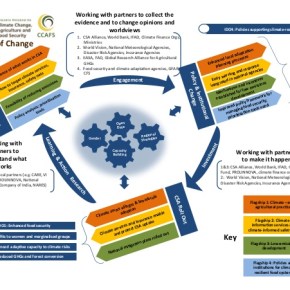
A ‘theory of change’ for agricultural research for development
The following are highlights of a new CGIAR paper advancing ways to make agricultural science make a bigger difference to development outcomes. We describe a theory-of-change approach to an agricultural research for development program. Continue reading
Livestock for sustainable and equitable development—Selected top advocacy communications of 2016
This year, with a pilot project funded by the Bill & Melinda Gates Foundation starting in Sep 2016, the International Livestock Research Institute (ILRI) stepped up its advocacy work supporting livestock development for a more sustainable and equitable world. The following are among ILRI’s top advocacy communications of 2016. Continue reading
Livestock environmental ‘hoofprints’: Five fast facts to remember—Shirley Tarawali at ‘Farming First’
In this guest post, originally published by Farming First, Shirley Tarawali, assistant director general of the International Livestock Research Institute (ILRI), takes a closer look at livestock’s impact on the environment, and what is being done to manage its environmental ‘hoofprint’. Continue reading
Access vs excess to antibiotics: The dual antimicrobial resistance issue facing the world
This opinion piece, written by ILRI scientist and program leader Delia Grace, was originally published by Devex on 16 Dec 2016. The numbers when it comes to drug resistance are apocalyptic. Already responsible for up to 700,000 deaths a year, the number of victims could reach 10 million by 2050, making superbugs a bigger killer than cancer is today if urgent action is not taken. Continue reading
What stops greater consumption of meat, milk and eggs in low-income areas of Nairobi? Price, mostly
A new research paper by scientists at the International Livestock Research Institute (ILRI) and partner organizations confirms that milk, meat and eggs are widely consumed by poor people in Kenya’s capital city of Nairobi: these animal-source goods make up nearly 40% of the food budget and half of this is spent on dairy products. Economic analysis revealed a high propensity to consume animal-source foods and elasticities showed that, if their prices could be lowered, consumption of animal-source foods would rocket, benefiting both the nutritional status of poor consumers and the livelihoods of small-scale livestock producers. Continue reading
Fragmentation of the Athi-Kaputiei plains, outside Nairobi, has caused rapid declines in both pastoralism and wildlife
A new paper on the consequences of land fragmentation and fencing on rangelands outside Nairobi, Kenya, formerly rich with wildlife and critical for the functioning of Nairobi’s famed national park, has been published. All of the authors are former staff, and one former partner, of the International Livestock Research Institute (ILRI), where this research work was conducted. Continue reading
‘Meating’ in the middle on the ‘meat vs vegetarian’ diet debate at the climate change summit this week
What might seem like a silver bullet to reduce greenhouse gas emissions risks undermining other development goals such as ending hunger, improving health and eliminating poverty. We cannot ignore the important role that animal-source foods play, especially in developing countries, when we talk about tackling climate change. Instead we need to find a middle ground. Continue reading
A first look at ILRI’s new research programs: Policy, Value Chains and Livelihoods
A first look at a revamped ILRI program: Policy, Value Chains and Livelihoods Continue reading