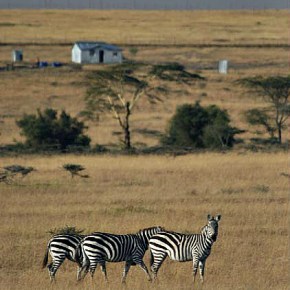
Results of a recent study by the Biosciences eastern and central Africa-International Livestock Research Institute Hub (BecA-ILRI Hub) and the Kenya Agricultural and Livestock Research Organization (KALRO), both based in Nairobi, indicate that the many people farming in Kenya’s semi-arid regions would profit in many ways from planting drought-tolerant Brachiaria grass. Continue reading
Category Archives: East Africa
Niall MacHugh
In sadness, the International Livestock Research Institute (ILRI) reports that Niall MacHugh, a long-term former scientist at ILRI and its predecessor, the International Laboratory for Research on Animal Diseases (ILRAD), died 21 Mar 2017. Continue reading
Uganda research-for-development work is helping to transform the country’s growing smallholder pig sector
The focus of the government of Uganda is to transform agriculture from subsistence to commercially oriented systems. The work being done by ILRI resonates with government’s objectives Continue reading
CGIAR livestock support is enhancing community resilience in the face of on-going drought in the Horn of Africa
Widespread drought conditions in the Horn of Africa have intensified since the failure of the Oct–Dec 2016 rains. Areas of greatest concern cover much of Somalia, northeast and coastal Kenya, southeast Ethiopia and the Afar region, and South Sudan, which faces a serious food crisis due to protracted insecurity. One focus of the East African-headquartered International Livestock Research Institute (ILRI) is to help developing-country livestock communities enhance their resilience in the face of recurring droughts. ILRI belongs to CGIAR—a global research partnership of 15 centres and their partners working yo reduce poverty, enhance food and nutrition security and improve natural resources and ecosystem services. Continue reading
Record payouts being made by Kenya Government and insurers to protect herders facing historic drought
More than Ksh214 million is on tap for 12,000 pastoral households in six counties of northern Kenya through innovative policies that use satellite imagery to trigger payments for feed, veterinary supplies and water. Continue reading
What stops greater consumption of meat, milk and eggs in low-income areas of Nairobi? Price, mostly
A new research paper by scientists at the International Livestock Research Institute (ILRI) and partner organizations confirms that milk, meat and eggs are widely consumed by poor people in Kenya’s capital city of Nairobi: these animal-source goods make up nearly 40% of the food budget and half of this is spent on dairy products. Economic analysis revealed a high propensity to consume animal-source foods and elasticities showed that, if their prices could be lowered, consumption of animal-source foods would rocket, benefiting both the nutritional status of poor consumers and the livelihoods of small-scale livestock producers. Continue reading
Fragmentation of the Athi-Kaputiei plains, outside Nairobi, has caused rapid declines in both pastoralism and wildlife
A new paper on the consequences of land fragmentation and fencing on rangelands outside Nairobi, Kenya, formerly rich with wildlife and critical for the functioning of Nairobi’s famed national park, has been published. All of the authors are former staff, and one former partner, of the International Livestock Research Institute (ILRI), where this research work was conducted. Continue reading
On selling insurance (not lottery tickets) to Africa’s struggling (stargazing) livestock herders–New York Times
Insurance that pays out when forage coverage drops—known as index-based livestock insurance—is an elegant idea. Andrew Mude, an economist and principal scientist at ILRI, last month was awarded the Norman Borlaug Award for Field Research and Application. The award, a major prize in agricultural research, is given by the World Food Prize Foundation and financed by the Rockefeller Foundation. Tina Rosenberg covers the story in the New York Times. Continue reading
Kenya’s wildlife populations are in ‘widespread’ and ‘catastrophic’ decline—New study
Here’s a wake up call for all those who care about Kenya’s rich heritage of wild animals, rangelands and pastoral peoples. A new study reporting on the period from 1977 to 2016 says wildlife on the rangelands of Kenya, which still support some of the richest herds of mammals on earth, is in precipitous decline while populations of goats and sheep are increasingly sharply. Continue reading
Kenyan economist Andrew Mude wins the 2016 Norman Borlaug Award for Field Research and Application
Andrew Mude, a principal research scientist at the International Livestock Research Institute (ILRI), in Nairobi, Kenya, was yesterday named the 5th recipient of a prestigious award for his work in providing insurance to livestock herders in East Africa’s drylands through innovative, state-of-the-art technologies. Continue reading