Recently, a consortium of Kenyan and international institutions launched a three-year surveillance project on three of those five priority zoonotic diseases with an inaugural workshop held on 3 September 2019, in Nairobi, Kenya. Continue reading
Category Archives: Regions
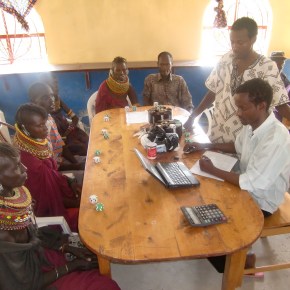
Index-based livestock insurance: Reflecting on success
One of the International Livestock Research Institute’s (ILRI’s) major success stories in recent years has been the development of an index-based livestock insurance program (IBLI), which protects livestock keepers in drought-prone arid and semi-arid lands from climate-related losses. Continue reading
Sustainable livestock systems for sustainable lives
This month, in a new issue of the science journal Animal Frontiers, ILRI scientist Padmakumar Varijakshapanicker leads authorship of a paper on Sustainable livestock systems to improve human health, nutrition, and economic status. Continue reading
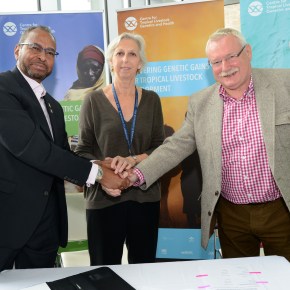
Centre for Tropical Livestock Genetics and Health celebrates five-year milestone and plans for its future
The Centre for Tropical Livestock Genetics and Health (CTLGH) had a double celebration on 27 September 2019 as it celebrated the achievements made in the first five years of its existence and the signing of a collaborative framework agreement between its founding partners to underpin its future for the next five years. Continue reading
‘Drylands and Rangelands: Harnessing Change’ at Global Landscapes Forum in New York
The International Livestock Research Institute (ILRI) is delighted to announce that a session devoted to drylands and rangelands is being incorporated in the agenda of a big event of the estimable Global Landscapes Forum, which is taking place all day tomorrow, in New York City. The theme of this forum, which led by ILRI’s sister CGIAR centre, the Centre for International Forestry Research (CIFOR), is ‘Restore the Earth: Opportunities and Partnerships’. Continue reading
Scientists test an experimental vaccine against malignant catarrhal fever at ILRI’s Kapiti Research Station
Scientists from ILRI, UK, US, Australia and Tanzania have been working together since 2016 to test an experimental vaccine for malignant catarrhal fever (MCF). They tested an attenuated vaccine strain of MCF (AlHV-1 C500) at ILRI’s Kapiti Research Station. Continue reading
ILRI and India’s National Institute of Animal Biotechnology to identify potential areas of research collaborations in livestock genetics and animal health
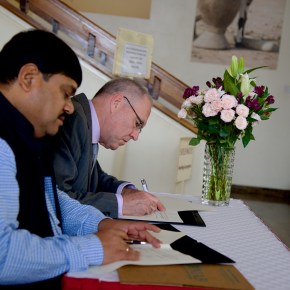
ILRI and India’s National Institute of Animal Biotechnology (NIAB) have formalized a partnership to work together in livestock genetics and animal health research programs for human and livestock development in India. Continue reading
Five years of the Centre for Tropical Livestock Genetics and Health: celebrating achievements and renewing commitments
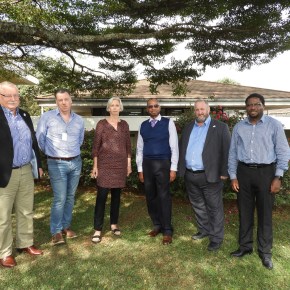
As the Centre for Tropical Livestock Genetics and Health (CTLGH) approached its five-year milestone, the principals of the founding partner organizations met at the International Livestock Research Institute (ILRI) to discuss the progress made so far and plan for the centre’s future. CTLGH’s vision is to ‘support more resilient, sustainable and profitable tropical … Continue reading
US ambassador to Mali visits communities in Sikasso region supported by an ILRI-led livestock technology scaling project
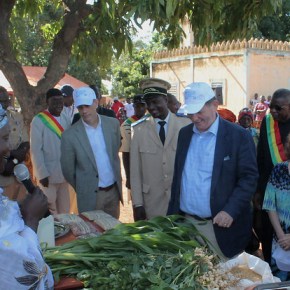
On 25 July 2019, the US ambassador to Mali, Dennis Hankins, visited Ifola village in Sikasso, Mali, to meet communities supported by the ILRI-led Feed the Future Mali Livestock Technology Scaling Program. Continue reading
Boosting Uganda’s action plans on livestock development – BMZ-funded project to tackle animal health challenges
In early June this year, policymakers, researchers, government and private sector representatives from Kenya, Germany and Uganda met in Kampala to launch the BuildUganda project. Funded by the German government, BuildUganda is a research for development collaboration to prevent and tackle animal diseases and zoonoses in Uganda. Its focus on ‘healthy animals for healthy food and healthy people’ reflects the importance of livestock in the lives and livelihoods of Uganda’s population. Continue reading