In October 2014, the Committee on Food Security requested the High-Level Panel of Experts for Food Security and Nutrition to prepare a report on sustainable agricultural development for food security and nutrition, including the role of livestock. An important planning meeting was held at the International Livestock Research Institute (ILRI). Continue reading
Tag Archives: Delia Grace
Livestock for better nutrition and disease control–One Health Colloquium held this week at Chatham House
Today and tomorrow (31 May–1 Jun 2016), Chatham House, the Livestock Global Alliance (LGA), the One Health Platform and other One Health partners are convening senior policymakers, academics, multilateral development agencies, business leaders and other private-sector stakeholders to discuss livestock’s role in poverty reduction, sustainable livestock production systems, innovations in livestock vaccines and diagnostics and the value of establishing national and regional One Health centres to provide advice on links among agriculture, sustainable livestock systems and human development. Continue reading
‘Zoonotic’ diseases take the spotlight of UN environmental talks this week and next in Nairobi, Kenya
Diseases transmitted between animals and people—which cause 60% of all human infectious diseases—are a ‘frontier issue’ at the second session of the United Nations Environment Assembly (UNEA2), being held this week and next at the United Nations Environment Programme (UNEP), in Nairobi, Kenya. Continue reading
‘One Health for the Real World’ (or, ‘real livestock for real global wellbeing’)
Twenty organizations, including ILRI, made up the Dynamic Drivers of Disease in Africa Consortium, which from 2012 to 2015 coordinated research exploring the relations among African ecosystems and zoonotic diseases—those transmitted between animals and people—that impinge on ecosystem, human and animal wellbeing. Continue reading
Is the ‘Third Epidemiological Transition’ upon us?
Zoonoses—diseases transferred from animals to humans—have been with humanity throughout history. But today’s growing scale of livestock production in developing countries to feed their fast-growing and fast-urbanizing populations is sparking debate about whether the livestock sector is contributing to a fundamental a shift in global disease mortality, something known as an ‘epidemiological transition’. If so, it would be the third such transition in human history. Continue reading
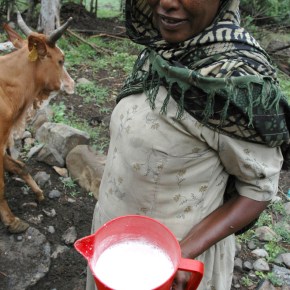
Aflatoxin levels in cow milk and feed in the Addis Ababa milk shed—New study
Ethiopian farmer with fresh milk from her cow (photo credit: ILRI/Apollo Habtamu). This article is written by ILRI scientists Dawit Gizachew, Barbara Szonyi, Azage Tegegne, Jean Hanson and Delia Grace Editor’s note: A statement in the article below, comparing various levels of risk, offended some of our readers. We thank those readers who let us … Continue reading
New study recommends continued research on the possible role pigs could play in transmitting Ebola in Uganda
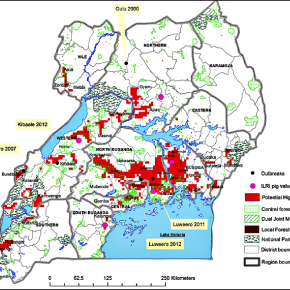
A new risk assessment paper, Assessing the potential role of pigs in the epidemiology of the Ebola virus in Uganda, was published in the science journal Transboundary and Emerging Diseases on 27 Aug 2015. The authors are scientists at the International Livestock Research Institute (ILRI). Presently, there is no solid evidence that pigs have any role in the past outbreaks of Ebola virus disease. But the risk assessment paper indicates that further research on the role pigs may play in Ebola virus transmission in Uganda is warranted. Continue reading
Towards professionalizing—not criminalizing—informal sellers of milk and meat in poor countries
Researchers from ILRI and partners have developed and piloted an institutional innovation—a training, certification and branding scheme for informal value chain actors—with good potential to improve the safety of animal-source foods sold in informal markets. Past development policy often focused on formal markets, which at best meant neglect of informal markets and often resulted in harassment and penalties for informal agents. Continue reading
Reducing human exposure to aflatoxins in poor countries: Towards new technologies and practices
A new paper describes and assesses the strength of a theory of change for how adoption of farm-level technologies and practices for aflatoxin mitigation can contribute to reductions in aflatoxin exposure among consumers in a market context. Continue reading
It’s showtime: ILRI’s series of ‘Hard Talk’ science interviews by Brian Perry
Brian Perry (left) interviews Mario Herrero in a ‘hard talk’ series at ILRI’s annual program meeting in 2006 in Nairobi (photo credit: ILRI). Several years ago, staff of the International Livestock Research Institute (ILRI) innovated ways to enliven their annual program meetings (aka, death by research powerpoint). One of the ways ILRI shook things up … Continue reading