Six new high-level publications by scientists and partners of the International Livestock Research Institute (ILRI) and the CGIAR Research Program on Agriculture for Nutrition and Health (A4NH) on zoonoses, livestock and well-being. Continue reading

Category Archives: Epidemiology
Honouring One Health Day–short video statement from Nobel Laureate and ILRI Patron Peter Doherty
Peter Doherty, an Australian veterinarian surgeon and researcher working in the field of medicine, who with his colleague Rolf Zinkernagel won the Nobel Prize for Physiology or Medicine in 1996 and who today serves as a patron of ILRI, also supports the integrated work—and the tearing down of disciplinary silos—that One Health approaches demand. Continue reading
A first look at ILRI’s new research programs: Animal and Human Health
A first look at a revamped ILRI research program: Animal and Human Health Continue reading
Improving food safety and human health through agricultural research: CGIAR future plans
A useful summary of the future plans of the CGIAR Research Program on Agriculture for Nutrition and Health (A4NH), led by the International Food Policy Research Institute (IFPRI), based in Washington, DC, has been published. Two of the five flagships of this multi-institutional research program are led or co-led by the International Livestock Research Institute (ILRI), based in Nairobi, Kenya. Future work of these two flagships is described below. Continue reading
Pandemic proofing the world: An epidemiologist in Nairobi on preventing the next Zika virus
As the world becomes more well, people — particularly people in the West — seem to be more worried about health and disease, especially about the possibility of global pandemics (that is, widespread outbreaks) of newly emerging infectious diseases. Are these first-world fears? Or is there good reason why everyone should be concerned about coming plagues? And, if so, what should we be doing differently to protect ourselves better from newly emerging diseases? Continue reading
Vaccine research on Africa’s cattle-killing East Coast fever: A short (somewhat potted but handsomely illustrated) history
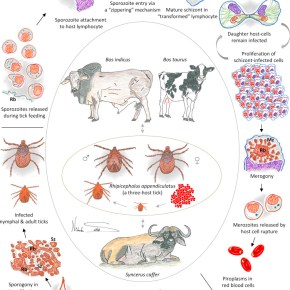
Tremendous research progress has been made over the last ten years to better control the deadly African disease of cattle known as East Coast fever. This disease is caused by a single-celled organism, Theileria parva, which is carried by some tick species. Cattle become infected when a tick carrying the parasite takes a blood-meal from the animal over several days. Continue reading
Livestock for better nutrition and disease control–One Health Colloquium held this week at Chatham House
Today and tomorrow (31 May–1 Jun 2016), Chatham House, the Livestock Global Alliance (LGA), the One Health Platform and other One Health partners are convening senior policymakers, academics, multilateral development agencies, business leaders and other private-sector stakeholders to discuss livestock’s role in poverty reduction, sustainable livestock production systems, innovations in livestock vaccines and diagnostics and the value of establishing national and regional One Health centres to provide advice on links among agriculture, sustainable livestock systems and human development. Continue reading
‘Zoonotic’ diseases take the spotlight of UN environmental talks this week and next in Nairobi, Kenya
Diseases transmitted between animals and people—which cause 60% of all human infectious diseases—are a ‘frontier issue’ at the second session of the United Nations Environment Assembly (UNEA2), being held this week and next at the United Nations Environment Programme (UNEP), in Nairobi, Kenya. Continue reading
‘One Health for the Real World’ (or, ‘real livestock for real global wellbeing’)
Twenty organizations, including ILRI, made up the Dynamic Drivers of Disease in Africa Consortium, which from 2012 to 2015 coordinated research exploring the relations among African ecosystems and zoonotic diseases—those transmitted between animals and people—that impinge on ecosystem, human and animal wellbeing. Continue reading
MERS-CoV antibodies found in two people in eastern Kenya
A new study published in the science journal Emerging Infectious Diseases reports that two individuals in Kenya have tested positive for the presence of antibodies to Middle East Respiratory Syndrome Corona Virus (MERS-CoV). Neither person is ill nor do they recall having any symptoms associated with MERS. There is no evidence of a public health threat and scientists concluded that the infections caused little or no clinical signs of illness. But they plan follow-up studies, as this is the first indication of a MERS-CoV infection that is not connected to primary infections in the Middle East. Continue reading