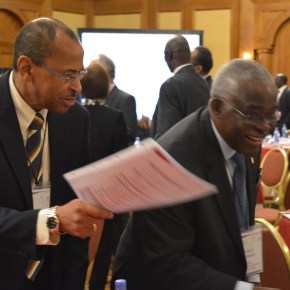
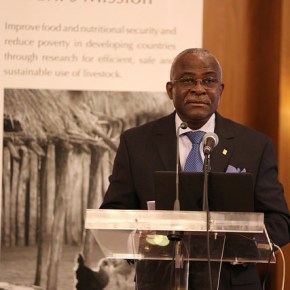
Jimmy Smith, director general of the International Livestock Research Institute (ILRI), gave one of three keynote presentations at the recent Agricultural Research Congress, held in Karnal, India, at the National Dairy Research Institute, from 3 to 6 Feb 2015. Continue reading
Category Archives: Livestock Systems
Lavish new pictorial book honours the world’s primary food producer–the family farmer
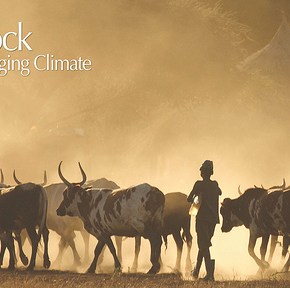
Livestock matters a great deal in developing countries, playing an increasingly important role in food security and economic development. In fact, the livestock subsector is growing faster than all other agriculture sectors in developing countries worldwide. And importantly in the International Year of Family Farming, the bulk of that livestock production is occurring on small family farms. Livestock farming offers unique features to support local livelihoods and economies, especially for women. Continue reading
Livestock and climate change: Where the BIG opportunities lie
Agricultural management can do only so much to increase the resilience, diversification and risk management of the developing world’s livestock-keeping communities. Their successful adaptation to climate change depends heavily also on their being supported by enabling policy and other environments. What that in turn depends on is reliable evidence of just how big a difference livestock adaptations can make to household incomes and food security provided in timely ways and appropriate formats. Continue reading
Animal agriculture research director envisions developing-world livestock sector in 2054
Jimmy Smith, director general of the International Livestock Research Institute (ILRI), provided a vision of what livestock production in the developing world will look like in 2054, 40 years from now. He presented this on the first of a two-day conference being held this week (6–7 Nov 2014) in Addis Ababa, Ethiopia, to mark the 40-year anniversary of ILRI. Continue reading
Help smallholders protect their environments and adapt to climate change––IFAD president challenges livestock researchers
In his keynote address to the ILRI@40 conference on the first morning, Kanayo Nwanze, president of the International Fund for Agricultural Development (IFAD), highlighted high-priority areas where livestock research can make the greatest contribution to poverty reduction and better food security in future. Continue reading
A major presentation on ‘the power of livestock’ to transform today’s resource-scarce agricultural lands
A major presentation was made at a special side event at the Borlaug Dialogue, in Iowa, on 15 Oct 2014. The side event was hosted by the International Livestock Research Institute (ILRI) and the Bill & Melinda Gates Foundation (BMGF) as part of a series marking ILRI’s 40-year anniversary this year. The presentation was made by Chris Delgado, who in 1999 led ground-breaking studies showing that a ‘Livestock Revolution’ was taking place in the global South. Continue reading
ILRI researchers test communication approaches for optimizing informed consent processes
The International Livestock Research Institute (ILRI) aims to employ the highest standards in its research, including the ways it engages with partners and stakeholders. Informed consent is a key approach to ensure that ILRI research is not exploiting the people it work with and aims to serve. Continue reading
Livestock innovation systems: Research contributions from ILRI over the decades
In this presentation, given at the Tropentag 2014 conference, Ann Waters-Bayer, a former ILRI researcher, looks back on her experiences of working with ILCA/ILRI, the impact of livestock innovation systems research and its role in driving development processes that improve the livelihoods of rural and urban resource-poor families. Continue reading
Mixing crops and livestock: Means for global food and nutritional security
A slide presentation ILRI director general Jimmy Smith presented last July on why we should care about the world’s ‘so-called ‘mixed’ crop-and-livestock agricultural systems. Continue reading
New map: Ruminant livestock distribution in Africa
Ruminant livestock are raised across large parts of Africa where environmental conditions allow. Cattle, sheep, and goats are the most widespread, while camels are restricted to drier areas, particularly in the Horn of Africa and the arid parts of western Africa. These maps of ruminant distribution should, however, be used in conjunction with the livestock production systems map to better understand the systems and climate zones where ruminant livestock are found. The role of livestock varies greatly depending on the production system. Continue reading