Click on the slides below to view a ‘Storify’ collection of highlights of inputs and outputs of the International Livestock Research Institute (ILRI) at the CGIAR Development Dialogues, held at Columbia University, in New York City, last week (25 Sep 2014). Continue reading
Category Archives: Regions
CTA-ILRI African dairy value chain seminar closes with colourful results
The International Livestock Research Institute (ILRI) and the Technical Centre for Agriculture and Rural Cooperation ACP-EU (CTA) organized the CTA-ILRI African dairy value chain seminar from 21 to 24 September 2014 in Nairobi, Kenya. Continue reading
Livestock options to meet development goals: ILRI side event at Tropentag Conference in Prague
A side event at the Tropentag 2014 International Conference, being held at the Czech University of Life Sciences, Prague, Czech Republic, is being organized tomorrow, 18 Sep 2014, from 1400–1530, by the International Livestock Research Institute (ILRI). Continue reading
New studies on MERS coronavirus and camels in eastern Africa published
Two new papers on MERS (Middle Eastern respiratory syndrome) coronavirus and camels in Eastern Africa have been published in the science journal ‘Emerging Infectious Diseases’; three of the authors are ILRI scientists. Continue reading
Gerardine Mukeshimana, BecA-ILRI Hub plant researcher, appointed minister of agriculture and animal resources in Rwanda
Gerardine Mukeshimana, a plant researcher working at the BecA-ILRI Hub, has been appointed minister of agriculture and animal resources in Rwanda. Continue reading
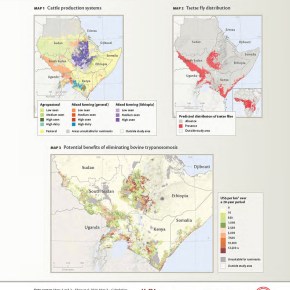
New map: Benefits of controlling trypanosomosis in the Horn of Africa
Using the Horn of Africa as an example, the maps illustrate different steps in a methodology developed to estimate and map the economic benefits to livestock keepers of controlling a disease (Shaw et al. 2014). Cattle are first assigned to different production systems as shown in Map 1, illustrating for example, where mixed farming is heavily dependent on the use of draft oxen in Ethiopia, areas of Sudan and South Sudan where oxen use is much lower, and the strictly pastoral areas of Somalia and Kenya. Continue reading
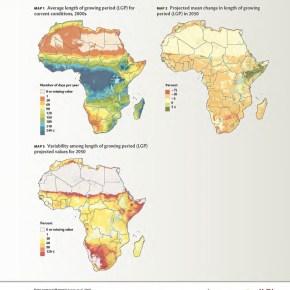
New map: Impacts of climate change on length of growing periods in Africa
Impacts of climate change on length of growing periods in Africa by Philip Thornton The International Food Policy Research Institute (IFPRI) has published an atlas illustrating the current state of African smallholder agriculture. The Atlas of African Agriculture Research and Development comprises a series of maps and short analyses that showcase and locate the continent’s diverse agricultural … Continue reading
New map: Rainfall and rainfall variability in Africa
An average of less than 1,000 millimeters of rain falls per year across most of Africa (Map 1). Rainfall tends to decrease with distance from the equator and is negligible in the Sahara (north of about latitude 16°N), in eastern Somalia, and in the southwest of the continent in Namibia and South Africa. Rainfall is most abundant on the eastern seaboard of Madagascar; portions of the highlands in eastern Africa; large areas of the Congo Basin and central Africa; and parts of coastal western Africa including Liberia, Sierra Leone, and Guinea. Continue reading
New map: Ruminant livestock distribution in Africa
Ruminant livestock are raised across large parts of Africa where environmental conditions allow. Cattle, sheep, and goats are the most widespread, while camels are restricted to drier areas, particularly in the Horn of Africa and the arid parts of western Africa. These maps of ruminant distribution should, however, be used in conjunction with the livestock production systems map to better understand the systems and climate zones where ruminant livestock are found. The role of livestock varies greatly depending on the production system. Continue reading
New map: Livestock and mixed crop-livestock systems in Africa
Livestock-producing agricultural systems cover 73 percent of Africa and stretch across several climates (Map 1). To some extent, these climates determine what type of farming is practiced. In Africa, livestock-producing systems are broken into two main categories: livestock and mixed crop-livestock. These systems exist in three common African climates: arid/semiarid, humid/subhumid, and temperate/tropical highlands. Continue reading