U.S resolution recognises that One Health is ‘essential to combating and strengthening the surveillance of emerging and reemerging disease’ and calls for integrating efforts by professionals from several disciplines—including health, science, technology and engineering—to address increasing threats posed by emerging diseases at the human-animal-environmental interface. Continue reading
Category Archives: Zoonotic Diseases
Bird flu and other diseases transmitted from animals to humans
ONE HEALTH FOR AFRICA: Germany’s BMZ initiates a new ‘One Health Research, Education and Outreach Centre for Africa’
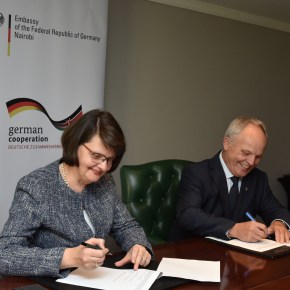
Today, the German Federal Ministry for Economic Cooperation and Development (BMZ) and ILRI signed a letter of intent to establish a ‘One Health Research, Education and Outreach Centre for Africa’ (OHRECA) to be hosted by ILRI, which is headquartered in Nairobi, Kenya. Continue reading
OneHealthDay is this Sunday: Join ILRI in collaborative work for healthier people, animals and lands
ILRI researchers have been investigating diseases that afflict both people and animals in an ecosystem context for more than 40 years. ILRI’s animal health and environmental scientists have found One Health approaches to highly useful in their work. Continue reading
Workshop inaugurates surveillance project on human and animal diseases in Kenya
Recently, a consortium of Kenyan and international institutions launched a three-year surveillance project on three of those five priority zoonotic diseases with an inaugural workshop held on 3 September 2019, in Nairobi, Kenya. Continue reading
Boosting Uganda’s action plans on livestock development – BMZ-funded project to tackle animal health challenges
In early June this year, policymakers, researchers, government and private sector representatives from Kenya, Germany and Uganda met in Kampala to launch the BuildUganda project. Funded by the German government, BuildUganda is a research for development collaboration to prevent and tackle animal diseases and zoonoses in Uganda. Its focus on ‘healthy animals for healthy food and healthy people’ reflects the importance of livestock in the lives and livelihoods of Uganda’s population. Continue reading
Minimizing the risks of Rift Valley fever in Uganda – BuildUganda project to build national surveillance and response capacities
In early June this year, the BuildUganda research for development project was launched at a workshop with stakeholders. One of the four components of the project is focused on controlling Rift Valley fever (RVF) in Uganda. This component specifically aims to minimize the impacts of RVF by improving capacities for surveillance and response at national and community levels, leading to better risk prediction, evidence-based disease control policies, and improved awareness about the disease. Continue reading
Six new papers on the ancient, complex and everlasting farm animal–zoonotic disease–human well-being nexus
Six new high-level publications by scientists and partners of the International Livestock Research Institute (ILRI) and the CGIAR Research Program on Agriculture for Nutrition and Health (A4NH) on zoonoses, livestock and well-being. Continue reading
Livestock for food security and nutrition—Committee on World Food Security policy recommendations
The following policy recommendations build on the main findings of the CFS High Level Panel of Expert’s Jul 2016 report #10, on Sustainable agricultural development for food security and nutrition: What roles for livestock? The sustainable development of agriculture, including livestock, is essential for poverty reduction and the achievement of food security and nutrition. Continue reading
Livestock and human health – highlights from ILRI’s corporate report 2015–2016
The experience of the International Livestock Research Institute (ILRI) and partner scientists in 2015–2016 unmistakably identifies the potential benefits to smallholder farmers and consumers of research into livestock and human health. Smallholder farmers could potentially save hundreds of millions of US dollars annually, following breakthroughs in the development of vaccines for contagious bovine pleuropneumonia and Rift Valley fever, the latter posing a serious threat to human as well as animals. However, it was the participation in high-level fora and implementation strategies which are likely to deliver the rapid life changes for smallholder farmers on the ground. Continue reading
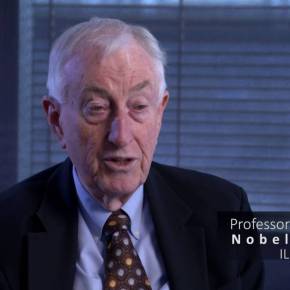
Medicine Nobel Laureate Peter Doherty is patron of the International Livestock Research Institute
Peter Doherty is today patron of two institutes: the Peter Doherty Institute for Infection and Immunity, a joint venture between the University of Melbourne and the Royal Melbourne Hospital researching infectious diseases in humans that became operational in 2014, and the International Livestock Research Institute (ILRI), for whose predecessor, the International Laboratory for Research on Animal Diseases (ILRAD), Doherty served for several years as a board member overseeing the science program. Continue reading