This Jun 2015, Evidence on Demand, an international development information hub supported by the UK Department for International Development (DFID), published a 44-page paper identifying key evidence gaps in our knowledge of livestock- and fisheries-linked antimicrobial resistance in the developing world and documenting on-going and planned research on this topic by key stakeholders.The paper, written by veterinary epidemiologist and food safety expert Delia Grace, of the International Livestock Research Institute (ILRI), is titled: Review of evidence on antimicrobial resistance and animal agriculture in developing countries. Continue reading
Category Archives: Emerging Diseases
Food scares: Agrifood systems everywhere need greater cooperation and investments in safer foods and farming
An interesting, if scary, read is chapter 6 of the recently launched flagship report of IFPRI on reducing and managing food scares, co-written by Delia Grace at ILRI and John McDermott, who directs the CGIAR Research Program on Agriculture for Nutrition and Health, led by IFPRI. Continue reading
First global map of the rising use of antimicrobial drugs in farm animals published in PNAS
As reported last week in a scientific paper published in the Proceedings of the National Academy of Science (PNAS), Global trends in antimicrobial use in food animals, worldwide antimicrobial consumption is expected to rise by a staggering 67% between 2010 and 2030. Continue reading
One-for-all and all-for-one: Breaking down the walls between the livestock, health and environmental sectors
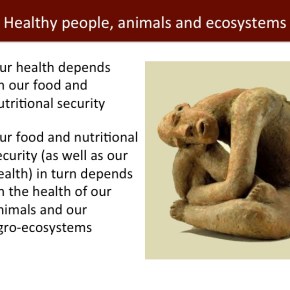
In case you missed it, here is the gist of a keynote presentation on ‘one-health’ made by Jimmy Smith, the director general of the International Livestock Research Institute (ILRI), at the 5th biennial conference of the International Association for Ecology & Health, held in Montreal, Canada, 11−15 Aug 2014. Smith’s presentation was titled: ‘Healthy people, animals and ecosystems for global food and nutritional security’. Continue reading
Livestock policy paradoxes: Promulgating a crisis? Or providing a solution
Jimmy Smith, director general of the International Livestock Research Institute (ILRI), gave a keynote presentation at the 16th Asian Australasian Animal Production Congress, held in Yogyakarta, Indonesia, 10–14 Nov 2014. The overall theme of the congress was ambitious: ‘Sustainable livestock production in the perspective of food security, policy, genetic resources and climate change’. Smith’s plenary keynote, given as part of a series of ILRI activities to mark the 40-year anniversary of the institute, was titled ‘Livestock policy paradoxes: Promulgating a crisis? Or providing a solution?’ Continue reading
African Animal Annals: Deadly trifecta of climate change, population and disease?
All fine artwork on this page is by Olivia Pendergast (see note below for more information). In the last quarter of 2014 a book was published and launched on climate change and public health. Edited by Colin Butler, of the University of Canberra, and published by CABI, the book brings together 56 authors from 19 … Continue reading
New studies on MERS coronavirus and camels in eastern Africa published
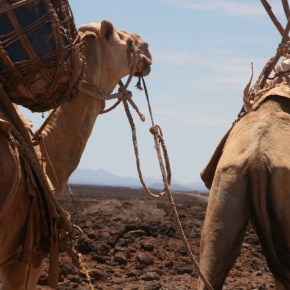
Two new papers on MERS (Middle Eastern respiratory syndrome) coronavirus and camels in Eastern Africa have been published in the science journal ‘Emerging Infectious Diseases’; three of the authors are ILRI scientists. Continue reading
Deadly strain of bird flu in China linked to live poultry markets; high-risk spots in Asia mapped–New study
A new study reveals conditions linked to the emergence and spread of deadly bird flu and maps the areas of Asia at greatest risk of the spread of the new virus strain. A dangerous strain of avian influenza, H7N9, that’s causing severe illness and deaths in China may be inhabiting a small fraction of its potential range and appears at risk of spreading to other suitable areas of India, Bangladesh, Vietnam, Indonesia and the Philippines, according to a new study published today in the journal Nature Communications. Continue reading
New UK funding for disease surveillance will improve health and farming in Kenya
The University of Liverpool has been given funding to start a surveillance program to reduce the incidence of diseases transmitted between people and livestock in western Kenya. The £3.6 million grant will train veterinary and medical technicians to monitor farms, markets and slaughterhouses. They will use a mobile data collection system to generate a comprehensive database of the prevalence and economic impact of these diseases. The information generated will be used to provide evidence for government health policy in the area. Continue reading
Hard numbers: Making the business case for massive investments in ‘One Health’ to protect ‘One World’
The time has come to make the bigger case for massive investment in One Health to transform the management of neglected and emerging zoonoses and to save the lives of millions of people and hundreds of millions of animals whose production supports and nourishes billions of impoverished people per annum. Continue reading