Managing the most nutritious, and riskiest, foods in the informal markets of developing countries
A4NH / Africa / Agri-Health / Animal Products / Consumption / Disease Control / Epidemiology / Food Safety / FSZ / Human Health / ILRI / Kenya / Nigeria / Nutrition / Opinion Piece / Spotlight

Managing the most nutritious, and riskiest, foods in the informal markets of developing countries

A new book compiling 25 contemporary studies on food safety in Africa’s informal markets offers (surprising) lessons for much of the developing world. Continue reading

Despite contamination concerns, Africa must embrace ‘wet markets’ as key to food security
A4NH / Africa / Agri-Health / Animal Products / Books and Chapters / Brucellosis / Disease Control / Food Safety / FSZ / Human Health / ILRI / Markets / Research / Spotlight / Women

Despite contamination concerns, Africa must embrace ‘wet markets’ as key to food security

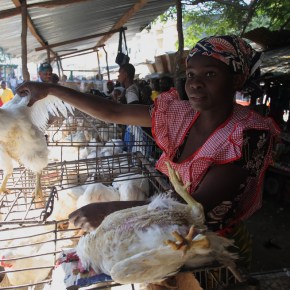
A new compilation of 25 studies in Africa finds that informal markets provide essential sources of food and income for millions of poor, with milk and meat that is often safer than supermarkets. Misguided efforts to control the alarming burden of food-related illnesses in low-income countries risk intensifying malnutrition and poverty — while doing little to improve food safety. Blunt crack-downs on informal milk and meat sellers that are a critical source of food and income for millions of people are not the solution. Continue reading

African Animal Annals: Deadly trifecta of climate change, population and disease?
A4NH / Africa / Agri-Health / Bird flu / Books and Chapters / Climate Change / Disease Control / Emerging Diseases / FSZ / Human Health / ILRI / RVF / Spotlight / Zoonotic Diseases

African Animal Annals: Deadly trifecta of climate change, population and disease?

All fine artwork on this page is by Olivia Pendergast (see note below for more information). In the last quarter of 2014 a book was published and launched on climate change and public health. Edited by Colin Butler, of the University of Canberra, and published by CABI, the book brings together 56 authors from 19 … Continue reading

African animal agriculture:  Grasping opportunities as a great livestock transition gets under way
Africa / Animal Production / Animal Products / Directorate / Event / ILRI / ILRI40 / Kenya / Presentation / Pro-Poor Livestock / Spotlight

African animal agriculture: Grasping opportunities as a great livestock transition gets under way

ILRI director general Jimmy Smith made a keynote presentation at the 6th All African Conference on Animal Agriculture (AACAA), held at the Kenyatta International Conference Centre, in Nairobi, Kenya, 27–29 Oct 2014. The slide presentation is above and a summary below. Continue reading

ILRI turns 40: Nairobi headquarters marks the anniversary
Africa / Animal Breeding / Animal Diseases / Animal Feeding / Animal Production / Capacity Strengthening / Directorate / Event Report / Food Security / ILRI / ILRI40 / Innovation Systems / Insurance / Markets / Policy / Research / Spotlight

ILRI turns 40: Nairobi headquarters marks the anniversary

Highlights of the 40-year anniversary event of the International Livestock Research Institute (ILRI) held at the institute’s headquarters in the Kabete suburb of Nairobi, Kenya, last week (1 Oct 2014). Continue reading

CTA-ILRI African dairy value chain seminar closes with colourful results
Africa / Dairying / East Africa / Event / ILRI / Livestock / LIVESTOCKFISH / Markets / PIL / PIM / Value Chains / Women

CTA-ILRI African dairy value chain seminar closes with colourful results

The International Livestock Research Institute (ILRI) and the Technical Centre for Agriculture and Rural Cooperation ACP-EU (CTA) organized the CTA-ILRI African dairy value chain seminar from 21 to 24 September 2014 in Nairobi, Kenya. Continue reading

New map: Impacts of climate change on length of growing periods in Africa
Africa / Agriculture / Books and Chapters / CCAFS / Climate Change / Geodata / ILRI / ILRIComms / Knowledge and Information / SLS / Spotlight

New map: Impacts of climate change on length of growing periods in Africa

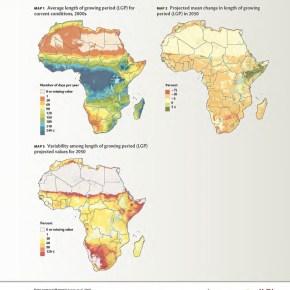
Impacts of climate change on length of growing periods in Africa by Philip Thornton The International Food Policy Research Institute (IFPRI) has published an atlas illustrating the current state of African smallholder agriculture. The Atlas of African Agriculture Research and Development comprises a series of maps and short analyses that showcase and locate the continent’s diverse agricultural … Continue reading

New map: Rainfall and rainfall variability in Africa
Africa / Agriculture / Books and Chapters / CCAFS / Geodata / ILRI / ILRIComms / Knowledge and Information / SLS / Spotlight / Water

New map: Rainfall and rainfall variability in Africa

An average of less than 1,000 millimeters of rain falls per year across most of Africa (Map 1). Rainfall tends to decrease with distance from the equator and is negligible in the Sahara (north of about latitude 16°N), in eastern Somalia, and in the southwest of the continent in Namibia and South Africa. Rainfall is most abundant on the eastern seaboard of Madagascar; portions of the highlands in eastern Africa; large areas of the Congo Basin and central Africa; and parts of coastal western Africa including Liberia, Sierra Leone, and Guinea. Continue reading

New map: Ruminant livestock distribution in Africa
Africa / Agriculture / Books and Chapters / Geodata / ILRI / ILRIComms / Knowledge and Information / Livestock / Livestock Systems / SLS / Spotlight

New map: Ruminant livestock distribution in Africa

Ruminant livestock are raised across large parts of Africa where environmental conditions allow. Cattle, sheep, and goats are the most widespread, while camels are restricted to drier areas, particularly in the Horn of Africa and the arid parts of western Africa. These maps of ruminant dis­tribution should, however, be used in conjunction with the livestock production systems map to better under­stand the systems and climate zones where ruminant live­stock are found. The role of livestock varies greatly depending on the production system. Continue reading