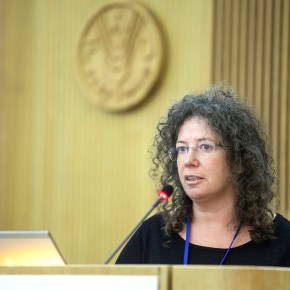
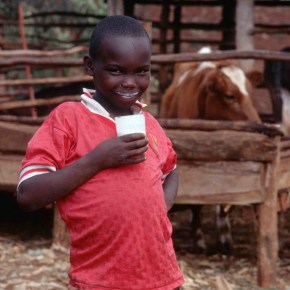
In this guest post, originally published by Farming First, Shirley Tarawali, assistant director general of the International Livestock Research Institute (ILRI), takes a closer look at livestock’s impact on the environment, and what is being done to manage its environmental ‘hoofprint’. Continue reading
Category Archives: Spotlight
Access vs excess to antibiotics: The dual antimicrobial resistance issue facing the world
This opinion piece, written by ILRI scientist and program leader Delia Grace, was originally published by Devex on 16 Dec 2016. The numbers when it comes to drug resistance are apocalyptic. Already responsible for up to 700,000 deaths a year, the number of victims could reach 10 million by 2050, making superbugs a bigger killer than cancer is today if urgent action is not taken. Continue reading
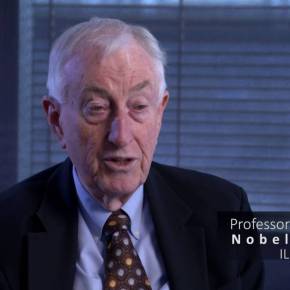
Medicine Nobel Laureate Peter Doherty is patron of the International Livestock Research Institute
Peter Doherty is today patron of two institutes: the Peter Doherty Institute for Infection and Immunity, a joint venture between the University of Melbourne and the Royal Melbourne Hospital researching infectious diseases in humans that became operational in 2014, and the International Livestock Research Institute (ILRI), for whose predecessor, the International Laboratory for Research on Animal Diseases (ILRAD), Doherty served for several years as a board member overseeing the science program. Continue reading
Tom Randolph, director of the new CGIAR Research Program on Livestock Agri-food Systems
Tom Randolph, who has served as director of the CGIAR Research Program on Livestock and Fish for the last five years, has been newly appointed director of the CGIAR Research Program on Livestock Agri-food Systems, which begins operations in Jan 2017 (photo credit: ILRI/Stevie Mann). Continue reading
Livestock opportunities for responsible, inclusive and sustainable business-for-development partnerships
This week, Jimmy Smith, director general of the International Livestock Research Institute (ILRI), led a delegation from ILRI to the Second High-Level Meeting of the Global Partnership for Effective Development Cooperation (GPEDC HLM2), held in Nairobi, Kenya. On 30 Nov 2016, Smith participated in a panel discussion highlighting the essential role of business in achieving the Sustainable Development Goals (SDGs) and providing guidance for how governments and development partners can support responsible, inclusive and sustainable business. Continue reading
What stops greater consumption of meat, milk and eggs in low-income areas of Nairobi? Price, mostly
A new research paper by scientists at the International Livestock Research Institute (ILRI) and partner organizations confirms that milk, meat and eggs are widely consumed by poor people in Kenya’s capital city of Nairobi: these animal-source goods make up nearly 40% of the food budget and half of this is spent on dairy products. Economic analysis revealed a high propensity to consume animal-source foods and elasticities showed that, if their prices could be lowered, consumption of animal-source foods would rocket, benefiting both the nutritional status of poor consumers and the livelihoods of small-scale livestock producers. Continue reading
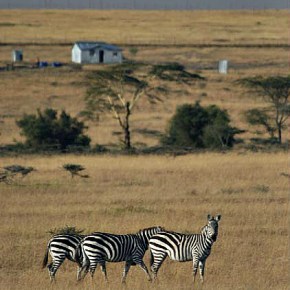
Fragmentation of the Athi-Kaputiei plains, outside Nairobi, has caused rapid declines in both pastoralism and wildlife
A new paper on the consequences of land fragmentation and fencing on rangelands outside Nairobi, Kenya, formerly rich with wildlife and critical for the functioning of Nairobi’s famed national park, has been published. All of the authors are former staff, and one former partner, of the International Livestock Research Institute (ILRI), where this research work was conducted. Continue reading
On selling insurance (not lottery tickets) to Africa’s struggling (stargazing) livestock herders–New York Times
Insurance that pays out when forage coverage drops—known as index-based livestock insurance—is an elegant idea. Andrew Mude, an economist and principal scientist at ILRI, last month was awarded the Norman Borlaug Award for Field Research and Application. The award, a major prize in agricultural research, is given by the World Food Prize Foundation and financed by the Rockefeller Foundation. Tina Rosenberg covers the story in the New York Times. Continue reading
Unpacking the tensions between the nutritional and economic goals of pro-poor livestock development
Discussants at this event unpacked the tensions inherent between developing livestock markets to meet economic goals of the poor and meeting the nutritional needs of poor households raising livestock. Continue reading
Honouring One Health Day–short video statement from Nobel Laureate and ILRI Patron Peter Doherty
Peter Doherty, an Australian veterinarian surgeon and researcher working in the field of medicine, who with his colleague Rolf Zinkernagel won the Nobel Prize for Physiology or Medicine in 1996 and who today serves as a patron of ILRI, also supports the integrated work—and the tearing down of disciplinary silos—that One Health approaches demand. Continue reading