A Boran calf and girl in eastern Kenya (photo credit: ILRI/Stevie Mann). A new study of the cattle killer East Coast fever finds a protective process that may also be at work in human malaria: Infections with milder parasites may protect against severe disease. African cattle infected with a lethal parasite that kills one million … Continue reading
Category Archives: Kenya
ILRI Kenya staff appointments: January–February 2015
Updated on ILRI Kenya staff appointments January–February 2015. Continue reading
Case study on the first insurance for Africa’s camels, cows, sheep and goats
Iddo Dror prepared this case study with case writer Shreya Maheshwari and IBLI team leader Andrew Mude as the
basis for class discussion rather than to illustrate either effective or ineffective handling of an administrative situation.
This case was prepared in collaboration with the IBLI team and benefited from useful insights by a range of partners
and collaborators of the IBLI program. Continue reading
African animal agriculture: Grasping opportunities as a great livestock transition gets under way
ILRI director general Jimmy Smith made a keynote presentation at the 6th All African Conference on Animal Agriculture (AACAA), held at the Kenyatta International Conference Centre, in Nairobi, Kenya, 27–29 Oct 2014. The slide presentation is above and a summary below. Continue reading
This week ILRI hosts a major conference in Nairobi on livestock-based options for development
On Wednesday 1 Oct 2014, ILRI will host a high-profile conference in Nairobi on livestock’s contribution to sustainable food and nutritional security, economic well-being and healthy lives. Continue reading
ILRI Kenya staff appointments: July–August 2014
Update on ILRI Nairobi national staff appointments July–August 2014. Continue reading
New studies on MERS coronavirus and camels in eastern Africa published
Two new papers on MERS (Middle Eastern respiratory syndrome) coronavirus and camels in Eastern Africa have been published in the science journal ‘Emerging Infectious Diseases’; three of the authors are ILRI scientists. Continue reading
Scottish and Kenya scientists in new alliance to improve animal breeding and health in developing countries
Challenges faced by livestock farmers in tropical developing countries are the focus of a new alliance involving researchers from Scotland and Africa. The new Centre for Tropical Livestock Genetics and Health will initially focus on the use of genetic information to improve the health and productivity of farmed animals in tropical climates. Continue reading
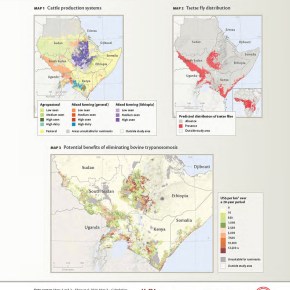
New map: Benefits of controlling trypanosomosis in the Horn of Africa
Using the Horn of Africa as an example, the maps illustrate different steps in a methodology developed to estimate and map the economic benefits to livestock keepers of controlling a disease (Shaw et al. 2014). Cattle are first assigned to different production systems as shown in Map 1, illustrating for example, where mixed farming is heavily dependent on the use of draft oxen in Ethiopia, areas of Sudan and South Sudan where oxen use is much lower, and the strictly pastoral areas of Somalia and Kenya. Continue reading
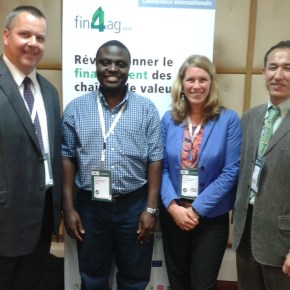
Accessing finance for livestock and dairy value chains in developing countries: Recommendations
This week (15 Jul 2014), the International Livestock Research Institute (ILRI) organized a discussion at CTA’s Fin4Ag Conference in Nairobi on ‘Testing innovations in livestock and dairy value chain finance: Insights from East and Southern Africa’. The discussion was moderated by Jo Cadilhon, a senior agro-economist in ILRI’s Policy, Trade and Value Chains Program who is based at the institute’s Nairobi headquarters. Continue reading