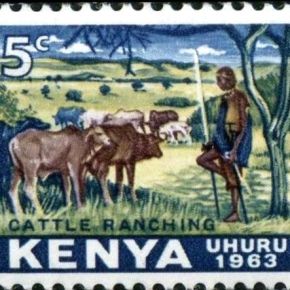
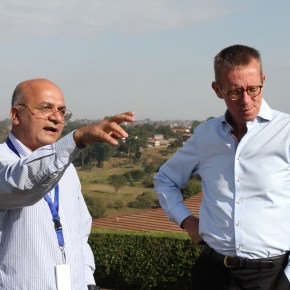
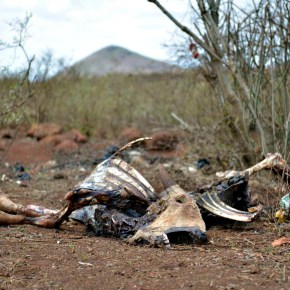
Robin Mbae, deputy director of livestock production at the Kenya Ministry of Agriculture, Livestock and Fisheries, describes Kenya’s planning and implementation of interventions to address the impacts of climate change on the livestock sector and vice versa. Continue reading
Category Archives: Drylands
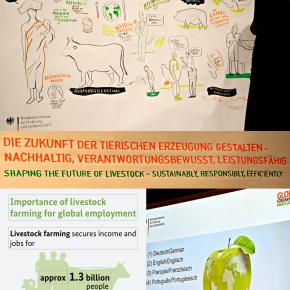
Towards a sustainable, responsible and efficient livestock sector—Jimmy Smith at the Berlin Global Forum for Food and Agriculture
A delegation from the International Livestock Research Institute (ILRI) was involved in several of this year’s GFFA events, including a kick-off event, with ILRI Director General Jimmy Smith serving on the panel. Continue reading
ILRI’s Kapiti livestock research station—and Kenyan and global public goods—imperiled by land grabs in Kenya
Over the past several weeks, illegal attempts to grab land have escalated at Kapiti Plains Estate (‘Kapiti’, or ‘Kapiti research station’), located about 60 km southeast of Nairobi along Mombasa Road, in Machakos County. Members of groups involved in the illegal sales have started trespassing and building illegal structures on Kapiti research station. No land at Kapiti is for sale. Continue reading
Award-winning paper establishes links between women’s empowerment and crop seed improvement and governance in pre-war Syria
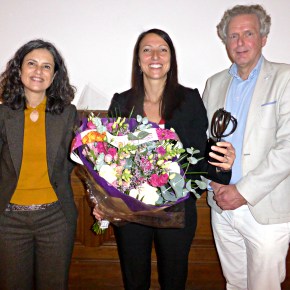
Alessandra Galiè, a social scientist specializing in gender issues in agricultural research who now works in Nairobi, Kenya, at the International Livestock Research Institute (ILRI), conducted her doctoral research in Aleppo, Syria, at ILRI’s sister CGIAR institution, the International Centre for Agricultural Research in the Dry Areas (ICARDA). This week Galiè received a prestigious award for an academic paper she published documenting how ICARDA’s participatory barley breeding program in pre-war Syria impacted women’s empowerment. Continue reading
Largest-ever micro-insurance payout made to Ethiopian pastoralists
More than 2,250 pastoralists received insurance payouts following the extremely poor rains this year in southern Ethiopia. Low levels of rainfall have led to the loss of approximately 300,000 livestock in 2017 in the Borana zone of the southern Oromia region. The insurance payouts of more than ETB5.233 million (USD220,000) was the largest-ever micro-insurance indemnity made in Ethiopia. Each insured pastoralist received an average of ETB2,255 (USD96), which will allow the herders to purchase feeds for their surviving animals and to restock their herds. Continue reading
Brachiaria grass can help Kenya’s dryland food producers improve their soils and yields under a changing climate
Results of a recent study by the Biosciences eastern and central Africa-International Livestock Research Institute Hub (BecA-ILRI Hub) and the Kenya Agricultural and Livestock Research Organization (KALRO), both based in Nairobi, indicate that the many people farming in Kenya’s semi-arid regions would profit in many ways from planting drought-tolerant Brachiaria grass. Continue reading
Research to help secure rangelands for users presented at World Bank Land and Poverty Conference
Together with its partners, the International Livestock Research Institute (ILRI) has now taken its research agenda on adaptation and resilience a notch higher, at the on-going Annual World Bank Conference on Land and Poverty themed ‘Responsible Land Governance—Towards an Evidence-Based Approach’. ILRI is one of the major partners that have supported this premier global forum on land governance. Continue reading
CGIAR livestock support is enhancing community resilience in the face of on-going drought in the Horn of Africa
Widespread drought conditions in the Horn of Africa have intensified since the failure of the Oct–Dec 2016 rains. Areas of greatest concern cover much of Somalia, northeast and coastal Kenya, southeast Ethiopia and the Afar region, and South Sudan, which faces a serious food crisis due to protracted insecurity. One focus of the East African-headquartered International Livestock Research Institute (ILRI) is to help developing-country livestock communities enhance their resilience in the face of recurring droughts. ILRI belongs to CGIAR—a global research partnership of 15 centres and their partners working yo reduce poverty, enhance food and nutrition security and improve natural resources and ecosystem services. Continue reading
Record payouts being made by Kenya Government and insurers to protect herders facing historic drought
More than Ksh214 million is on tap for 12,000 pastoral households in six counties of northern Kenya through innovative policies that use satellite imagery to trigger payments for feed, veterinary supplies and water. Continue reading
On selling insurance (not lottery tickets) to Africa’s struggling (stargazing) livestock herders–New York Times
Insurance that pays out when forage coverage drops—known as index-based livestock insurance—is an elegant idea. Andrew Mude, an economist and principal scientist at ILRI, last month was awarded the Norman Borlaug Award for Field Research and Application. The award, a major prize in agricultural research, is given by the World Food Prize Foundation and financed by the Rockefeller Foundation. Tina Rosenberg covers the story in the New York Times. Continue reading