Originally posted on ILVAC:
Written by Bernard Bett Several outbreaks of Rift Valley fever in livestock and people have occurred in eastern Africa over the last three months or so. In the first week of June 2018, local media reported at least five fatal human cases in Kenya’s northern Wajir County. More suspected cases in…
Category Archives: AHH
Animal and Human Health program
Livestock-enhanced diets in the first 1,000 days of life: Pathways to better futures in low-income countries
A new report was published this month on the value of ensuring consumption of meat, milk and eggs by infants up to two years of age and by expectant and new mothers in developing countries (the first 1,000 days). The report was published by ILRI and the Chatham House Centre on Global Health Security. Highlights of the findings of this joint ILRI-Chatham livestock study were presented at a side event at the EAT Stockholm Food Forum on 11 Jun 2018. Continue reading
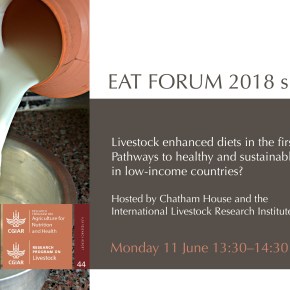
Can livestock-enhanced diets of the poor in the first 1,000 days of life lead to healthy and sustainable futures?
This year’s EAT 2018 Stockholm Food Forum (11–12 Jun 2018) explores ways to achieve healthy and sustainable diets for a growing global population. On Monday, 11 Jun 2018, Chatham House and ILRI will host a side event around the findings of an evidence review on the influence of livestock-derived foods—meat, milk and eggs—on the nutrition of women and of children during their first 1,000 days of life, from conception to age two. Continue reading
Why milk, meat and eggs can make a big difference to the world’s most nutritionally vulnerable people
Opinion piece by ILRI scientist Silvia Alonso on the ILRI-Chatham House report on the importance of livestock-derived foods in the first 1,000 days of life. Continue reading
Meat, milk, eggs can make a big difference in the first 1,000 days of life in low-income countries—New report
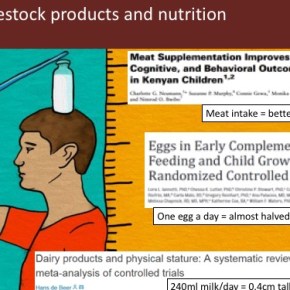
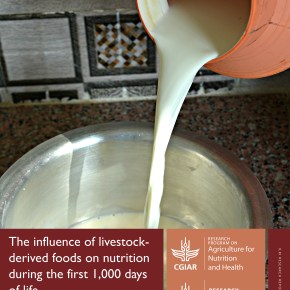
An extensive review of research found demonstrable nutritional benefits of providing children, particularly in countries in Africa and South Asia where undernutrition is highest, with livestock-derived foods such as meat, milk and eggs. Consumption of livestock-derived foods was typically found to be very low among poor families in those countries. The influence of livestock-derived foods on nutrition during the first 1,000 days of life, published by the International Livestock Research Institute (ILRI) and Chatham House, also concluded that it was possible to meet the nutritional needs of the most vulnerable through livestock-derived produce even if total global livestock production slowed down. Continue reading
On the need for expanding sustainability frameworks and veterinary vision in developing countries
A new science paper argues for broadening traditional approaches to livestock sustainability and veterinary vision in developing countries. Two of the three livestock science authors—Brian Perry and Tim Robinson—have formerly worked at the International Livestock Research Institute (ILRI) while the third—Delia Grace—co-leads ILRI’s Animal and Human Health program. Continue reading
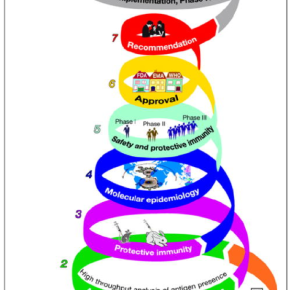
‘Living tools’ at the frontier of vaccine development—A Keystone Symposium workshop by Vish Nene
Vish Nene, one of the scientific organizers of the conference and a co-leader of the Animal and Human Health program at the International Livestock Research Institute (ILRI), headquartered in Nairobi, Kenya, gave a particularly lucid talk at the pre-meeting workshop on Novel tools and genomics approaches supporting vaccine development. The following is a transcript of Nene’s talk, lightly edited for clarity and brevity. Continue reading
Sustainable livestock futures—BMZ, GIZ and ILRI at the Global Forum for Food and Agriculture this week
For several days this week (18–20 Jan 2018), several scientific directors and staff of the International Livestock Research Institute (ILRI)—Jimmy Smith, Shirley Tarawali, Dieter Schillinger, Lutz Merbold and Kristina Roesel—will be participating with several ILRI partners in the Global Forum for Food and Agriculture (GFFA), held in Berlin, Germany. This annual German three-day international conference focuses on the future of the global agri-food industry. Now in its tenth year, the GFFA in 2018 is focusing on Shaping the Future of Livestock—Sustainably, Responsibly, Efficiently. Continue reading
Beyond meat and methane—Advocating for sustainable livestock production
A Global Livestock Advocacy for Development (GLAD) project is distilling evidence around livestock ‘goods’ and ‘bads’, reaching out to UN and other global policy processes and events, engaging global media and developing a group of champions—individuals capacitated to make the case for sustainable livestock. Continue reading
Imposing user fees on veterinary antimicrobials is a plausible way to curb antimicrobial use in food animals
New research findings suggest that imposing a user fee on veterinary antimicrobials is a plausible policy option to achieve meaningful reductions in antimicrobial use in the short term while simultaneously raising funds to improve farming practices that will benefit the long-term viability of the livestock industry. Continue reading