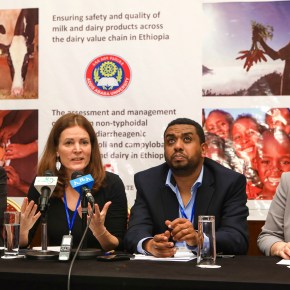
The UK Government’s Department for International Development (DFID) and the Bill & Melinda Gates Foundation (BMGF) are supporting four new research projects to address a broad set of robust and large-scale research priorities to guide program and policy efforts to improve food safety in Ethiopia. This will be achieved through a consortium of national and international research partners working together to support the country’s ongoing efforts. Continue reading
Category Archives: Policy
A world where livestock are part of the solution—Ethiopia state minister
The recent EAT-Lancet Commission report includes many valid points about livestock, but misses an opportunity to contextualize diverse food production systems outside rich, developed countries. This opinion piece was written by Gebregziabher Gebreyohannes, state minister in the Ethiopian Ministry of Agriculture and a board member of the International Livestock Research Institute (ILRI). Continue reading
Sustainable livestock goes digital
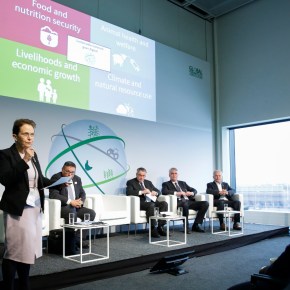
On Thursday 17 January 2019, the Global Agenda for Sustainable Livestock (GASL), the Food and Agriculture Organization of the UN (FAO), the World Organisation for Animal Health (OIE) and ILRI hosted a workshop on the theme of ‘Sustainable livestock goes digital’ at the 11th Global Forum for Food and Agriculture (GFFA) in Berlin. Continue reading
Should we eat red meat? Depends on who’s eating—New York Times
A particularly sane, sensible and equitable news report—one that takes an uncommon global perspective about optimal meat consumption—reviews recent diet guidelines recommended by some of the world’s foremost scientists in diet-, health- and environment-related fields and published in a leading medical journal. Continue reading
Celebrating achievements of women in livestock development at the African Women in Agricultural Research and Development (AWARD@10) event
Originally posted on ILRI policies, instititions and livelihoods program:
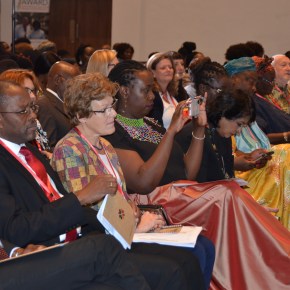
ILRI staff attended the African Women in Agricultural Research and Development (AWARD) @ 10 event in Nairobi on 29 November 2018 (photo credit: ILRI/Judy Kimani).? The International Livestock Research Institute (ILRI) supports women in livestock development by ensuring that they benefit and are empowered through livestock.…
This week: A global event on Accelerating the End of Hunger and Malnutrition
A senior delegation from the International Livestock Research Institute (ILRI) is supporting and engaging in this week’s (2830 Nov 2018) global conference on ‘Accelerating the End of Hunger and Malnutrition’, in Bangkok. Continue reading
Call to improve food safety in low- and middle-income countries—From hazards to risks and from farm to fork
A new report strengthens the economic case for increased public investment and other policy attention on food safety in developing countries. It synthesizes evidence of the economic costs of unsafe food in relation to both domestic markets and trade, positions food safety as an integral part of economic development and food system modernization, and provides guidance on improving food safety awareness and behaviour from farm to fork. Continue reading
Greenhouse gas emissions from dung patches in developing countries are ‘likely highly overestimated’—New report
A new research paper published by scientists of the Mazingira Centre (‘mazingira’ means ‘environment’ in Swahili) of the Nairobi-based International Livestock Research Institute (ILRI) reports evidence that greenhouse gas emissions from dung patches in developing countries are ‘likely highly overestimated’ in global livestock emissions estimates. Continue reading
IFPRI, ILRI leaders: Sustainable small-scale livestock farming is essential to meeting the 21st-century’s protein needs
Food research organizations say sustainable small-scale livestock farming is essential to meeting the 21st-century’s protein needs. Continue reading
The Tanzanian livestock master plan: A conversation with Barry Shapiro
Using what’s called the Livestock Sector Investment Policy Toolkit (LSIPT), we develop a dynamic herd model and an economic sector model on top of that. And we use that to do an analysis of the current situation of the livestock sector and its potential for further development, modernization, transformation, and so on, over 15 years. Continue reading