The focus of the government of Uganda is to transform agriculture from subsistence to commercially oriented systems. The work being done by ILRI resonates with government’s objectives Continue reading
Category Archives: Regions
The legacy of Norman Borlaug: Alive and well at the International Livestock Research Institute
ILRI was honoured by a visit this week to ILRI by Julie Borlaug (left) and Jeannie Borlaug Laube, granddaugher and daughter of Norman Borlaug, respectively. Continue reading
A deep dive inside Vietnam’s pork foodshed to determine food safety issues and their practical resolutions
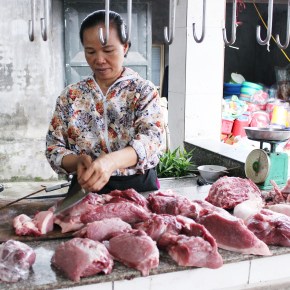
Pork meat sold in Vietnam has been found by researchers to commonly carry bacteria that could cause disease—but they also found that the risk of that meat sickening people is largely reduced due to the Vietnamese habit of buying very fresh meat and cooking it shortly thereafter. The research results indicate ways that the safety of pork meat can be even further improved in this fast-growing and -evolving market. The bottom line is that ensuring safe pork consumption in Vietnam is very important—and very doable. Continue reading
Beef value chain actors reap big gains from new financing in Southern Africa
Efforts by research and development partners are offering renewed hope for livestock financing in Southern Africa. This was revealed at an International Conference on Livestock Value Chain Finance and Access to Credit, organized by the International Livestock Research Institute (ILRI) in partnership with the Swaziland Water and Agricultural Development Enterprise (SWADE) and Swaziland’s Micro Finance Unit (MFU) 21-23 Feb 2017. Continue reading
Making livestock foods safe—Lessons from Vietnam on what works—and what doesn’t
The experiences of developed countries, which now have relatively safe food, is that command-and-control approaches to food safety, which rely mainly on inspection and punishment, are less effective than approaches in which stakeholders are empowered and encouraged to self-regulate, motivated by the realisation that this is more profitable in the long term. Continue reading
New Nutrition Knowledge Bank gives direct access to expert nutritional advice via mobile phones
A new open-access Nutrition Knowledge Bank has been created as part of a GSMA mNutrition initiative to help tackle malnutrition in Africa and Asia. This collection of content on good nutritional practices includes factsheets and mobile messages for anyone to download and use. Funded by the UK Department for International Development (DFID), the mNutrition project aims to deliver nutrition information to 3 million people in 12 developing countries. Continue reading
CGIAR livestock support is enhancing community resilience in the face of on-going drought in the Horn of Africa
Widespread drought conditions in the Horn of Africa have intensified since the failure of the Oct–Dec 2016 rains. Areas of greatest concern cover much of Somalia, northeast and coastal Kenya, southeast Ethiopia and the Afar region, and South Sudan, which faces a serious food crisis due to protracted insecurity. One focus of the East African-headquartered International Livestock Research Institute (ILRI) is to help developing-country livestock communities enhance their resilience in the face of recurring droughts. ILRI belongs to CGIAR—a global research partnership of 15 centres and their partners working yo reduce poverty, enhance food and nutrition security and improve natural resources and ecosystem services. Continue reading
Record payouts being made by Kenya Government and insurers to protect herders facing historic drought
More than Ksh214 million is on tap for 12,000 pastoral households in six counties of northern Kenya through innovative policies that use satellite imagery to trigger payments for feed, veterinary supplies and water. Continue reading
What stops greater consumption of meat, milk and eggs in low-income areas of Nairobi? Price, mostly
A new research paper by scientists at the International Livestock Research Institute (ILRI) and partner organizations confirms that milk, meat and eggs are widely consumed by poor people in Kenya’s capital city of Nairobi: these animal-source goods make up nearly 40% of the food budget and half of this is spent on dairy products. Economic analysis revealed a high propensity to consume animal-source foods and elasticities showed that, if their prices could be lowered, consumption of animal-source foods would rocket, benefiting both the nutritional status of poor consumers and the livelihoods of small-scale livestock producers. Continue reading
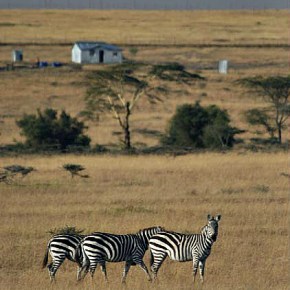
Fragmentation of the Athi-Kaputiei plains, outside Nairobi, has caused rapid declines in both pastoralism and wildlife
A new paper on the consequences of land fragmentation and fencing on rangelands outside Nairobi, Kenya, formerly rich with wildlife and critical for the functioning of Nairobi’s famed national park, has been published. All of the authors are former staff, and one former partner, of the International Livestock Research Institute (ILRI), where this research work was conducted. Continue reading