Eight staff from Tanzania’s Ministry of Livestock and Fisheries Development are undergoing a 14-month training and planning program assisted by experts from the International Livestock Research Institute (ILRI) with funding from the Bill & Melinda Gates Foundation. Continue reading
Category Archives: Dairying
Towards more productive dairy cattle for Africa’s smallholders
Improving the genetic makeup of Africa’s dairy cattle has the potential increase farmer productivity and profitability, hence transform the lives of millions of dairy families across Africa. This latest program, African Dairy Genetic Gains (ADGG) program, led by the International Livestock Research Institute (ILRI), offers real opportunities to help smallholders improve their lives through livestock. It also contributes to ILRI’s global livestock genetics program—LiveGene. Continue reading
No longer business as usual: Improved feeds transforming dairying in Zimbabwe
Farmers participating in the Zimbabwe Crop-Livestock Integration for Food Security (ZimCLIFS) project have increased their gross margins by up to 70%. The ongoing food security improvement project is targeting the country’s dairy farmers to help improve feed farming and overall dairy production. Continue reading
Aflatoxin levels in cow milk and feed in the Addis Ababa milk shed—New study
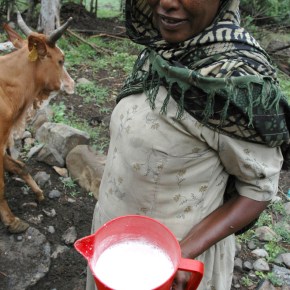
Ethiopian farmer with fresh milk from her cow (photo credit: ILRI/Apollo Habtamu). This article is written by ILRI scientists Dawit Gizachew, Barbara Szonyi, Azage Tegegne, Jean Hanson and Delia Grace Editor’s note: A statement in the article below, comparing various levels of risk, offended some of our readers. We thank those readers who let us … Continue reading
Towards professionalizing—not criminalizing—informal sellers of milk and meat in poor countries
Researchers from ILRI and partners have developed and piloted an institutional innovation—a training, certification and branding scheme for informal value chain actors—with good potential to improve the safety of animal-source foods sold in informal markets. Past development policy often focused on formal markets, which at best meant neglect of informal markets and often resulted in harassment and penalties for informal agents. Continue reading
Reducing human exposure to aflatoxins in poor countries: Towards new technologies and practices
A new paper describes and assesses the strength of a theory of change for how adoption of farm-level technologies and practices for aflatoxin mitigation can contribute to reductions in aflatoxin exposure among consumers in a market context. Continue reading
Small farmers and big retailing: What works? What doesn’t? in developing countries
What, or who, is a smallholder farmer? What is the ongoing retail revolution in developing countries all about? Are small-scale farmers involved? Two agricultural economists, Derek Baker, formerly of ILRI and now at the University of New England (UNE), in Australia, and Jo Cadilhon, of ILRI, help us think this through in a presentation they made at the GLOBALG.A.P. Summit in Abu Dhabi this week. Continue reading
CTA-ILRI African dairy value chain seminar closes with colourful results
The International Livestock Research Institute (ILRI) and the Technical Centre for Agriculture and Rural Cooperation ACP-EU (CTA) organized the CTA-ILRI African dairy value chain seminar from 21 to 24 September 2014 in Nairobi, Kenya. Continue reading
Accessing finance for livestock and dairy value chains in developing countries: Recommendations
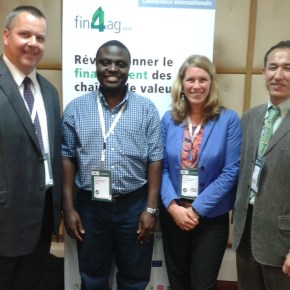
This week (15 Jul 2014), the International Livestock Research Institute (ILRI) organized a discussion at CTA’s Fin4Ag Conference in Nairobi on ‘Testing innovations in livestock and dairy value chain finance: Insights from East and Southern Africa’. The discussion was moderated by Jo Cadilhon, a senior agro-economist in ILRI’s Policy, Trade and Value Chains Program who is based at the institute’s Nairobi headquarters. Continue reading
Tanzanian dairy film: The workings of a successful dairy platform
This 5-minute film tells the story of the Tanzanian Tanga Dairy Platform, which is helping dairy farmers in Tanzania to improve their milk production and sales. Continue reading