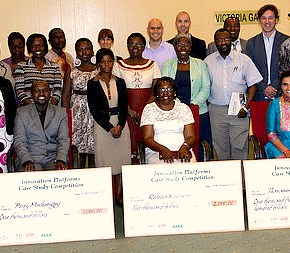
Participants at the award ceremony pose for a photo with the winners of the competition (seated, left to right): Perez Muchunguzi (3rd place), Rebecca Kalibwani (1st place) and Thanammal Ravichandran (2nd place) (photo credit: ILRI/Brian Kawuma). This article is written by Brian Kawuma, communications officer for ILRI in Uganda. From offering a legal precedent for … Continue reading
Category Archives: Agriculture
New Kenya value chains program to lift 300,000 plus households out of poverty
Starting in October 2015, ILRI, in partnership with two other CGIAR centres, has initiated a new three-year USD25 million program to help lift 317,000 households out of poverty, making them food secure and enabling their transition from subsistence to market-orientated farming. Continue reading
ILRI Board of Trustees meets in Washington DC
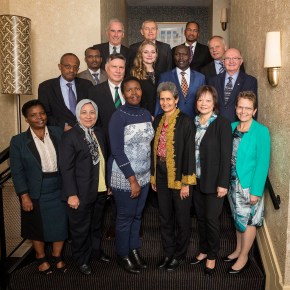
The 44th ILRI Board of Trustees meeting took place in Washington DC from 31 October to 4 November 2015. This latest meeting saw a number of changes on the ILRI board, as three members left, three joined, and Lindsay Falvey become board chair. Continue reading
Climate-smart livestock farming in developing countries is boosted by a £10-million research award
Researchers at the Roslin Institute will be using funds from the Bill & Melinda Gates Foundation to investigate how genetic information can improve the health and productivity of farmed animals in tropical climates, which is a proven approach to climate change mitigation and adaptation. The Centre for Tropical Livestock Genetics and Health is an alliance between the Institute at the University of Edinburgh, Scotland’s Rural College (SRUC) and the Africa-headquartered International Livestock Research Institute (ILRI). The partner institutions are making additional contributions with a value of £10 million to support the initiative over the next five years. Continue reading
High-level German delegation visits ILRI for updates on CGIAR livestock and sweet potato research
Earlier this week (16 Nov 2015) a delegation from the German Federal Ministry of Economic Cooperation and Development (BMZ) and the German Embassy in Kenya visited the International Livestock Research Institute (ILRI) in Nairobi. Continue reading
What’s driving Ethiopia’s fast development? Millions of smallholder farmers, of course
Industrialization is key to economic development, and agriculture—supplying raw materials for processing and value addition—is an essential component of that process. Comprising more than 40% of national GDP and producing the overwhelming majority of the Ethiopia’s food, smallholder farmers are at the centre of the country’s recent economic success. So declared the director general of the International Livestock Research Institute (ILRI), Jimmy Smith, in an agriculture panel discussion, this week, organized by the Economist magazine and held at the Sheraton Hotel in Addis Ababa. Continue reading
Unlocking the potential of Africa to scale livestock development, high-level conference
Improved livestock genetics, health and feed—guided by policies geared towards enabling a sustainable and business-friendly environment—are key to unlocking the potential of agriculture in Africa, Continue reading
Open letter to the heads of state attending the 70th UN General Assembly, September 2015, New York
Open letter to the heads of state attending the 70th UN General Assembly, September 2015, New York: ‘Co-advancement of Agricultural and Natural Resource Management within the United Nations Sustainable Development Goals’ Continue reading
ILRI deepens its engagement with partners in Asia
In recent weeks, ILRI has signed collaborative research agreements in China, India and Vietnam. These build on several years of past engagement and aim to deepen ILRI’s work in these and other countries in Asia. Continue reading
Mixing it up—The information ‘black hole’ on crop+animal recipes for climate-smart and climate-resilient farms
We are unaware of any comprehensive studies undertaken in sub-Saharan Africa to explore how mixed farms will be affected by climate change and the cost and benefits of different adaptation options. Underestimating the importance of livestock in the mixed’ smallholder farming systems that are ubiquitous across the developing world weakens both emissions reduction and climate change adaptation efforts. Continue reading