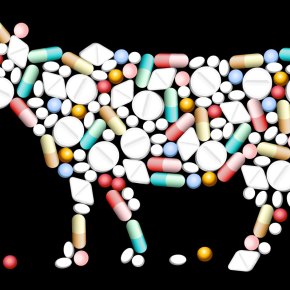
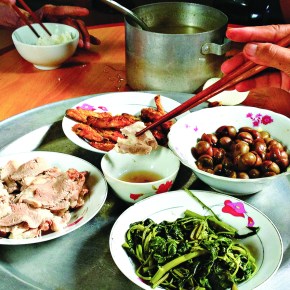
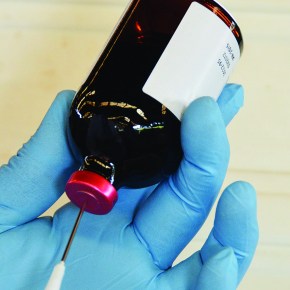
Launching today in Kenya is aCGIAR AMR Hubfor powering global, national and local partnershipsto help stem the global rise of drug-resistant pathogensthat is increasingly putting public health at risk. Continue reading

Category Archives: AHH
Animal and Human Health program
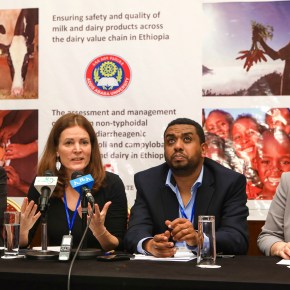
Six-million-dollar investment to tackle the causes of foodborne disease in Ethiopia
The UK Government’s Department for International Development (DFID) and the Bill & Melinda Gates Foundation (BMGF) are supporting four new research projects to address a broad set of robust and large-scale research priorities to guide program and policy efforts to improve food safety in Ethiopia. This will be achieved through a consortium of national and international research partners working together to support the country’s ongoing efforts. Continue reading
This week: A global event on Accelerating the End of Hunger and Malnutrition
A senior delegation from the International Livestock Research Institute (ILRI) is supporting and engaging in this week’s (2830 Nov 2018) global conference on ‘Accelerating the End of Hunger and Malnutrition’, in Bangkok. Continue reading
Call to improve food safety in low- and middle-income countries—From hazards to risks and from farm to fork
A new report strengthens the economic case for increased public investment and other policy attention on food safety in developing countries. It synthesizes evidence of the economic costs of unsafe food in relation to both domestic markets and trade, positions food safety as an integral part of economic development and food system modernization, and provides guidance on improving food safety awareness and behaviour from farm to fork. Continue reading
New World Bank report says food-borne illnesses cost USD110 billion per year in low- and middle-income countries
Originally posted on AgHealth:
Rinsing fresh fish in Accra, Ghana (photo credit: ILRI/Kennedy Bomfeh). A new World Bank study finds that the impact of unsafe food costs low- and middle-income economies about US$ 110 billion in lost productivity and medical expenses each year. Yet a large proportion of these costs could be avoided by adopting…
German agroecological livestock research investments are benefiting both people and the planet
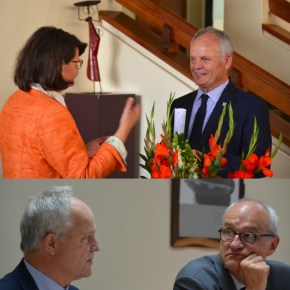
ILRI was honoured this week (3 Sep 2018) to host a high-level German delegation including Maria Flachsbarth, parliamentary state secretary to Germany’s federal minister for economic cooperation and development, and Stefan Schmitz, deputy director of the Federal Ministry of Economic Cooperation and Development (BMZ), as well as senior staff of the Kenya Ministry of Agriculture, Livestock, Fisheries and Irrigation, including Andrew Tuimur, chief administrative secretary, and Ann Onyango, agriculture secretary; and representatives from several other CGIAR centres working in Kenya, including Tony Simons, director general of ICRAF, and representatives from the Nairobi-based International Centre of Insect Physiology and Ecology (icipe). Continue reading
Deadly African swine fever arrives in China, the world’s largest producer of pigs
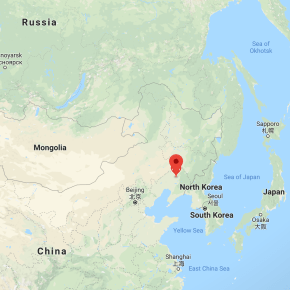
Long feared, it’s now finally happened. African swine fever (ASF), an infectious and highly lethal viral disease of pigs, has for the first time reared its head in China. Just two weeks ago, African swine fever was confirmed as the cause of death of pigs on a small farm in Shenyang City, in Liaoning Province, located in the northeast, bordering North Korea and the Yellow Sea. Continue reading
Reducing use of antimicrobial drugs in livestock in low-income countries: Two scientists reflect on options
Delia Grace Randolph, a veterinary epidemiologist and food safety expert who co-leads the Animal and Human Health program at ILRI, was interviewed recently by Wilton Park, a non-profit discussion centre in the UK. The event at which Grace spoke was a workshop held 11–13 Apr 2018 in West Sussex on Innovations to reduce the use of antimicrobials in food-producing animals in low- and middle-income countries. Continue reading
Translating food safety research into policy action in Vietnam
The agri-food sector, particularly livestock, plays an important role in the economy, livelihoods and nutritional security of Vietnamese people. More than 65% of rural households depend on pig farming for their livelihoods. Continue reading
Vaccinating farm animals helps drive up disposable incomes
East Coast fever causes annual losses estimated at more than USD300 million and more than one million cattle deaths. Recent research-for-development approaches have accelerated the uptake of the ITM vaccine and demonstrated how its use is driving increased incomes for small-scale livestock farmers in Kenya and Tanzania. Continue reading