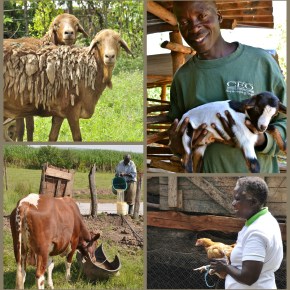
Improving the genetic makeup of Africa’s dairy cattle has the potential increase farmer productivity and profitability, hence transform the lives of millions of dairy families across Africa. This latest program, African Dairy Genetic Gains (ADGG) program, led by the International Livestock Research Institute (ILRI), offers real opportunities to help smallholders improve their lives through livestock. It also contributes to ILRI’s global livestock genetics program—LiveGene. Continue reading
Category Archives: LiveGene
Livestock Genetics program
Climate-smart livestock farming in developing countries is boosted by a £10-million research award
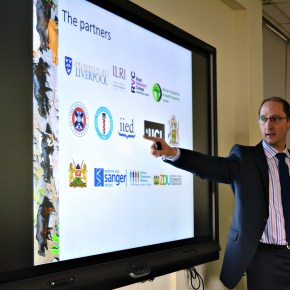
Researchers at the Roslin Institute will be using funds from the Bill & Melinda Gates Foundation to investigate how genetic information can improve the health and productivity of farmed animals in tropical climates, which is a proven approach to climate change mitigation and adaptation. The Centre for Tropical Livestock Genetics and Health is an alliance between the Institute at the University of Edinburgh, Scotland’s Rural College (SRUC) and the Africa-headquartered International Livestock Research Institute (ILRI). The partner institutions are making additional contributions with a value of £10 million to support the initiative over the next five years. Continue reading
Why communicate agricultural science to non-specialists? A brief for livestock geneticists
At a recent workshop co-hosted by an NGO called Biosciences for Farming in Africa (B4FA) and the International Livestock Research Institute (ILRI), in Nairobi, Kenya, ILRI communications staff Susan MacMillan made a short presentation on why the 20-plus animal geneticists in the room should bother communicating their science to non-specialists. The big picture ‘A … Continue reading
New DNA analysis of Asian sheep reveals unique diversity crucial to contemporary food and climate concerns
At a time when the price of mutton is climbing and wool crashing, a groundbreaking new study has used advanced genetic sequencing technology to rewrite the history of sheep breeding and trading along the ancient Silk Road—insights that can help contemporary herders in developing countries preserve or recover valuable traits crucial to their food and economic security. The new findings regarding one of the first animals ever domesticated will be published in the October print edition of the journal Molecular Biology and Evolution. They are the product of an unprecedented collaboration involving scientists in China, Iran, Pakistan, Indonesia, Nepal, Finland, and the United Kingdom. The team analysed the complete mitochondrial DNA of 42 domesticated native sheep breeds from Azerbaijan, Moldova, Serbia, Ukraine, Russia, Kazakhstan, Poland, Finland, China and the United Kingdom, along with two wild sheep species from Kazakhstan. Continue reading
Bridging ‘biobanking’ and biomedical research across Europe and Africa: ‘B3Africa’ launched in Cape Town
The first meeting of a new project, ‘B3Africa, short for ‘Bridging Biobanking and Biomedical Research across Europe and Africa’, was held this week (24–25 Aug 2015) at the University of the Western Cape, in Cape Town, South Africa. Continue reading
UK chief scientific adviser visits Kenya: Part 3—The dual rise of the global livestock sector and antimicrobial resistance
The second of two scientists to make a short presentation to Sir Mark Walport, the UK chief scientific adviser, on his 15 Jul 2015 visit to the International Livestock Research Institute (ILRI), in Nairobi, Kenya, was Tim Robinson, a livestock and spatial analysis expert. Continue reading
UK chief scientific adviser visits Kenya: Part 2—’One Health’ surveillance of infectious livestock-to-human diseases
The first scientist of two scientists to make a short presentation to Sir Mark Walport, the UK chief scientific adviser, on his 15 Jul 2015 visit to the International Livestock Research Institute (ILRI), in Nairobi, Kenya, was Eric Fèvre, a veterinary epidemiologist and joint appointee at ILRI and the Institute of Infection and Global Health at the University of Liverpool. Fèvre manages several field-oriented research projects on neglected zoonoses on behalf of the CGIAR Research Program on Agriculture for Nutrition and Health. Continue reading
Kenya’s native goats and sheep, expertly crossbred, are key to helping farmers cope with climate change
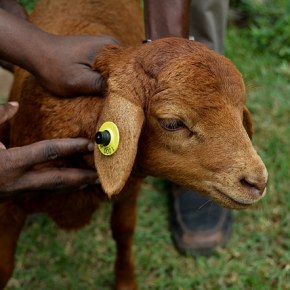
Smallholder farmers and pastoral herders in East Africa are the target of an ongoing joint project of ILRI, the Jomo Kenyatta University of Agriculture and Technology (JKUAT) and the CGIAR Research Program on Climate Change, Agriculture and Food Security (CCAFS). Continue reading
New project promises more productive chickens for Africa’s smallholders
A new four-year African Chicken Genetic Gains (ACGG) project funded by the Bill & Melinda Gates Foundation will run from 2015 to 2019 and work to genetically improve Africa’s chickens and to better deliver the superior chickens to small-scale farmers. Continue reading
Chickens rule — Everywhere — Everyday — Every way
When, exactly, did the chicken move out of our backyards and into our front rooms, taking over our kitchens and imaginations? When did it stop being a bird peasants kept to serve up the occasional egg, and the daily morning crow, and become meat for daily gobbling? Continue reading