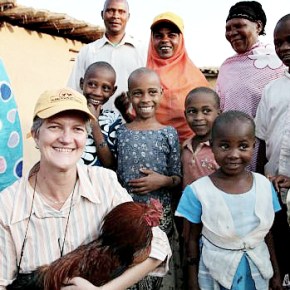
Poultry farming in Kenya is growing rapidly and remains largely dominated by women, who typically invest most of their earnings in feeding their families and educating their children. That is why controlling major poultry diseases is so important. Continue reading
Category Archives: Vaccines
Introducing English and Swahili instructional videos on the patterns, signs, symptoms and control of Rift Valley fever
Originally posted on ILVAC:
Written by Bernard Bett Several outbreaks of Rift Valley fever in livestock and people have occurred in eastern Africa over the last three months or so. In the first week of June 2018, local media reported at least five fatal human cases in Kenya’s northern Wajir County. More suspected cases in…
How closing livestock yield gaps can enhance incomes, food security and the environment in Ethiopia and India
Estimates of livestock yield gaps are not available and these are necessary for developing feasible scenarios of how the production of different livestock commodities might evolve in the future, how systems might change and what would be the resource use implications and their costs, both for donors and for public and private entities in target countries. Continue reading
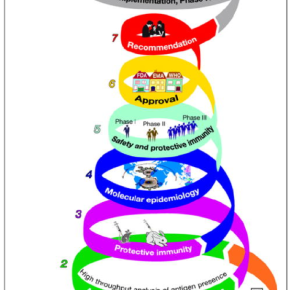
‘Living tools’ at the frontier of vaccine development—A Keystone Symposium workshop by Vish Nene
Vish Nene, one of the scientific organizers of the conference and a co-leader of the Animal and Human Health program at the International Livestock Research Institute (ILRI), headquartered in Nairobi, Kenya, gave a particularly lucid talk at the pre-meeting workshop on Novel tools and genomics approaches supporting vaccine development. The following is a transcript of Nene’s talk, lightly edited for clarity and brevity. Continue reading
Empowering ruminant livestock enterprises in Mali—A Feed the Future-ILRI project
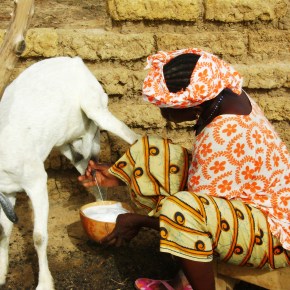
What happened in the Feed the Future Mali Livestock Technology Scaling Program (FTF-MLTSP) in early 2018? Open Day and stakeholder consultation for the program, PPR vaccine deployment, and market monitoring. Continue reading
Following the vaccine that wiped out rinderpest, a new vaccine against sheep and goat plague proves promising
A new paper by researchers at ILRI describes development of an effective experimental and thermostable vaccine against ‘peste des petits ruminants’, or PPR for short, a disease more commonly known as sheep and goat plague. Continue reading
Six new papers on the ancient, complex and everlasting farm animal–zoonotic disease–human well-being nexus
Six new high-level publications by scientists and partners of the International Livestock Research Institute (ILRI) and the CGIAR Research Program on Agriculture for Nutrition and Health (A4NH) on zoonoses, livestock and well-being. Continue reading
Lessons learnt out of Africa: 19 factors not to underestimate in rural livestock/agricultural research for development
Robyn Alders gave a particularly candid and interesting presentation at a seminar/webinar held on 4 May 2017 at ILRI on the subject of ‘Animal-source foods for nutrition impact: Evidence and good practices for informed project design’. This was the fourth in a Livestock and Household Nutrition Learning Series of seminars/webinars organized jointly by Land O’Lakes International Development and ILRI. Continue reading
Livestock and human health – highlights from ILRI’s corporate report 2015–2016
The experience of the International Livestock Research Institute (ILRI) and partner scientists in 2015–2016 unmistakably identifies the potential benefits to smallholder farmers and consumers of research into livestock and human health. Smallholder farmers could potentially save hundreds of millions of US dollars annually, following breakthroughs in the development of vaccines for contagious bovine pleuropneumonia and Rift Valley fever, the latter posing a serious threat to human as well as animals. However, it was the participation in high-level fora and implementation strategies which are likely to deliver the rapid life changes for smallholder farmers on the ground. Continue reading
Vaccine research on Africa’s cattle-killing East Coast fever: A short (somewhat potted but handsomely illustrated) history
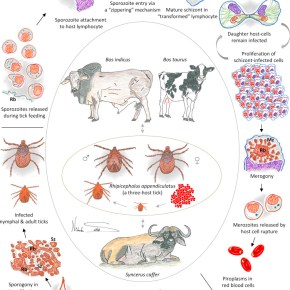
Tremendous research progress has been made over the last ten years to better control the deadly African disease of cattle known as East Coast fever. This disease is caused by a single-celled organism, Theileria parva, which is carried by some tick species. Cattle become infected when a tick carrying the parasite takes a blood-meal from the animal over several days. Continue reading