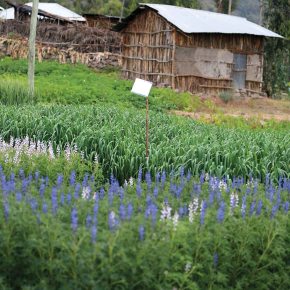
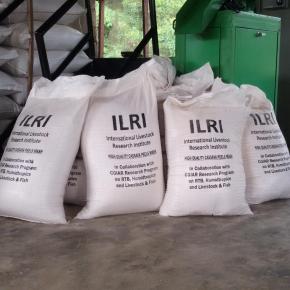
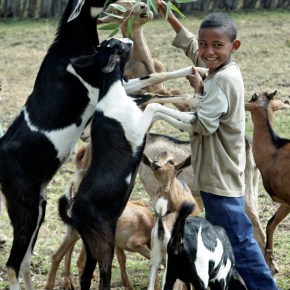
Results of a recent study by the Biosciences eastern and central Africa-International Livestock Research Institute Hub (BecA-ILRI Hub) and the Kenya Agricultural and Livestock Research Organization (KALRO), both based in Nairobi, indicate that the many people farming in Kenya’s semi-arid regions would profit in many ways from planting drought-tolerant Brachiaria grass. Continue reading
Category Archives: Feeds
Livestock feeds and forages – highlights from ILRI’s corporate report 2015–2016
The experience of the International Livestock Research Institute (ILRI) and partner scientists in 2015–2016 shows the positive benefits of implementing pioneering research and development interventions that increase the overall quantity and nutritional quality of feed biomass and help smooth seasonal feed variability, creating sustainable livelihood opportunities for smallholder livestock keepers. But the real scope for spreading the knowledge in this research lies in the development of on- and off-line tools that can be used by isolated smallholder farmers in accessing approaches for assessing feed constraints and developing effective feed and forage improvement interventions. Continue reading
A first look at ILRI’s new research programs: Feed and Forage Development
A first look at a revamped ILRI research program: Feed and Forage Development Continue reading
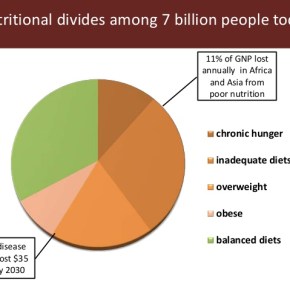
Balancing the plate: Jimmy Smith opens ‘Private Sector Mechanism Partnerships Forum on Livestock’
Private-Sector Mechanism Partnerships Forum on Livestock, 30 June 2016, IFAD, Rome: Luncheon on the ‘Zero Hunger Challenge’, Keynote address, ‘Balancing the Plate’, by Jimmy Smith, Continue reading
Elite cultivars of the livestock feeding kind–‘FORAGES for the FUTURE’
Just announced: Publication of the first issue of a newsletter produced by the Global Crop Diversity Trust that is a first step in fulfilling on a new strategy for tropical and subtropical forage diversity and use. Continue reading
Odisha Odyssey: A look at the emerging commercial dairy value chains in eastern India
In recent years, ILRI scientists have been working with institutional partners and local farmer organizations in Odisha, a large eastern state of India on the Bay of Bengal, on research to improve the feed and fodder resources readily available to smallholder livestock keepers. ILRI conducted this collaborative research through a collaborative CGIAR Cereal Systems Initiative for South Asia (CSISA) aiming to increase and sustain small farm productivity in selected regions of Bangladesh, India and Nepal.
As part of an ILRI photojournalism trip to India undertaken in early Mar 2016, the authors visited a town on the outskirts of Bhadrak, a city in northern Odisha, to capture a bit of what the ILRI-led CSISA work has accomplished for small-scale dairy farmers in the area. Continue reading
Some of ILRI’s top livestock slide presentations in 2015
A few of the top livestock slide presentations made by ILRI staff in 2015 Continue reading
Fragments d’ILRI : Traiter la peau du manioc, pour un milliard de dollars
La production d’animaux d’élevage devrait doubler dans les 40 années à venir et le traitement de la peau du manioc pour en tirer du fourrage de qualité pourrait s’avérer une stratégie de choix pour les économies africaines qui n’arrivent pas à combler la demande de produits d’origine animale, selon une étude récemment publiée par trois centres CGIAR. Continue reading
Fragments d’ILRI: Le plan directeur pour l’élevage en Ethiopie devrait aider 2.36 millions de ménages à sortir de la pauvreté
Depuis 20 ans, le gouvernement éthiopien compte sur une réelle transformation du secteur agricole, mais l’absence d’un plan directeur en a retardé la mise en œuvre. Cependant un nouveau projet de recherche interdisciplinaire, que Barry Shapiro – chercheur à l’Institut International pour la Recherche sur l’Elevage (ILRI) – a présenté au Ministère de l’Agriculture (MdA) à Addis Abeba, révèle les bénéfices potentiels d’un Plan Directeur pour l’Elevage (PDE, LMP en anglais) en Ethiopie. Continue reading
Processing African cassava peels, potentially a billion dollar business
With livestock production expected to more than double in the next 40 years, transforming cassava peels into high quality feed holds huge potential for African economies struggling to meet rapidly rising demand for animal-source products, according to research proposal recently published by three CGIAR centres. Continue reading