With global mobile technology growing exponentially, the opportunities for resource- and infrastructure-poor countries to rapidly expand learning are huge. Two projects managed by the International Livestock Research Institute (ILRI)—mNutrition and Index-Based Livestock Insurance (IBLI)—have seized this opportunity and developed mobile technology solutions to challenges they encountered. Continue reading
Category Archives: Africa
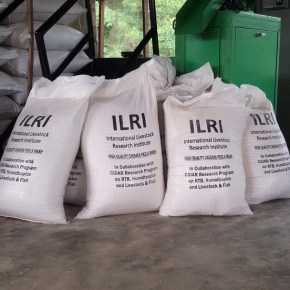
Processing African cassava peels, potentially a billion dollar business
With livestock production expected to more than double in the next 40 years, transforming cassava peels into high quality feed holds huge potential for African economies struggling to meet rapidly rising demand for animal-source products, according to research proposal recently published by three CGIAR centres. Continue reading
Climate-smart livestock farming in developing countries is boosted by a £10-million research award
Researchers at the Roslin Institute will be using funds from the Bill & Melinda Gates Foundation to investigate how genetic information can improve the health and productivity of farmed animals in tropical climates, which is a proven approach to climate change mitigation and adaptation. The Centre for Tropical Livestock Genetics and Health is an alliance between the Institute at the University of Edinburgh, Scotland’s Rural College (SRUC) and the Africa-headquartered International Livestock Research Institute (ILRI). The partner institutions are making additional contributions with a value of £10 million to support the initiative over the next five years. Continue reading
Unlocking the potential of Africa to scale livestock development, high-level conference
Improved livestock genetics, health and feed—guided by policies geared towards enabling a sustainable and business-friendly environment—are key to unlocking the potential of agriculture in Africa, Continue reading
Why communicate agricultural science to non-specialists? A brief for livestock geneticists
At a recent workshop co-hosted by an NGO called Biosciences for Farming in Africa (B4FA) and the International Livestock Research Institute (ILRI), in Nairobi, Kenya, ILRI communications staff Susan MacMillan made a short presentation on why the 20-plus animal geneticists in the room should bother communicating their science to non-specialists. The big picture ‘A … Continue reading
Mixing it up—The information ‘black hole’ on crop+animal recipes for climate-smart and climate-resilient farms
We are unaware of any comprehensive studies undertaken in sub-Saharan Africa to explore how mixed farms will be affected by climate change and the cost and benefits of different adaptation options. Underestimating the importance of livestock in the mixed’ smallholder farming systems that are ubiquitous across the developing world weakens both emissions reduction and climate change adaptation efforts. Continue reading
Bridging ‘biobanking’ and biomedical research across Europe and Africa: ‘B3Africa’ launched in Cape Town
The first meeting of a new project, ‘B3Africa, short for ‘Bridging Biobanking and Biomedical Research across Europe and Africa’, was held this week (24–25 Aug 2015) at the University of the Western Cape, in Cape Town, South Africa. Continue reading
Climate change impacts on livestock: ‘This information does not exist’
A new working paper from the CGIAR Research Program on Climate Change, Agriculture and Food Security (CCAFS) has been published on the impacts of climate change on livestock across Africa. Lead author of the new paper, Philip Thornton, is a scientist with the International Livestock Research Institute (ILRI). Continue reading
New project promises more productive chickens for Africa’s smallholders
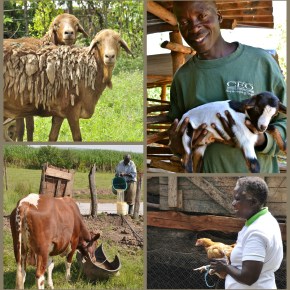
A new four-year African Chicken Genetic Gains (ACGG) project funded by the Bill & Melinda Gates Foundation will run from 2015 to 2019 and work to genetically improve Africa’s chickens and to better deliver the superior chickens to small-scale farmers. Continue reading
‘We’re having all the wrong debates’–Tamar Haspel
Award-winning journalist Tamar Haspel makes the case in her latest Washington Post column for exchanging our polarizing arguments about food issues for debates about stuff that really matters. Continue reading