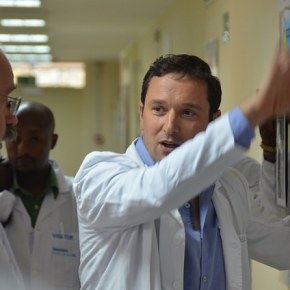
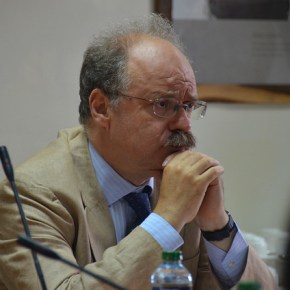
Brian Perry (left) interviews Mario Herrero in a ‘hard talk’ series at ILRI’s annual program meeting in 2006 in Nairobi (photo credit: ILRI). Several years ago, staff of the International Livestock Research Institute (ILRI) innovated ways to enliven their annual program meetings (aka, death by research powerpoint). One of the ways ILRI shook things up … Continue reading
Category Archives: Story Type
Designing practical ways to help the urban poor make choices that improve their nutrition
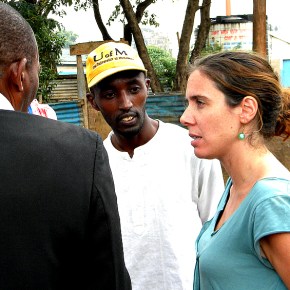
To improve interventions in food systems of the urban poor, scientists at the International Livestock Research Institute (ILRI) are investigating urban food and nutritional choices in two slums in Nairobi, Kenya. Their aim is to develop interventions that help people make food choices that improve their nutrition while staying within their low household food budgets and access. Continue reading
UK chief scientific adviser visits Kenya: Part 4—Development of a field-friendly diagnostic test for MERS
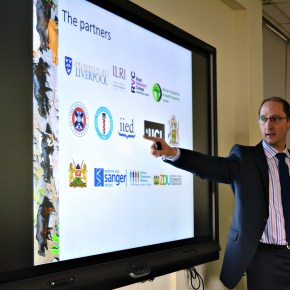
Among short presentations made to Sir Mark Walport, the UK chief scientific adviser, on his 15 Jul 2015 tour of the biosciences laboratories at the International Livestock Research Institute (ILRI), in Nairobi, Kenya, was one by Joerg Jores, a molecular biologist working to better control important livestock diseases of Africa and other developing regions. Jores is a senior scientist in ILRI’s Vaccine Biosciences program whose work supports the CGIAR Research Program on Livestock and Fish. Continue reading
UK chief scientific adviser visits Kenya: Part 3—The dual rise of the global livestock sector and antimicrobial resistance
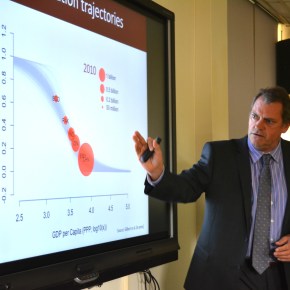
The second of two scientists to make a short presentation to Sir Mark Walport, the UK chief scientific adviser, on his 15 Jul 2015 visit to the International Livestock Research Institute (ILRI), in Nairobi, Kenya, was Tim Robinson, a livestock and spatial analysis expert. Continue reading
UK chief scientific adviser visits Kenya: Part 2—’One Health’ surveillance of infectious livestock-to-human diseases
The first scientist of two scientists to make a short presentation to Sir Mark Walport, the UK chief scientific adviser, on his 15 Jul 2015 visit to the International Livestock Research Institute (ILRI), in Nairobi, Kenya, was Eric Fèvre, a veterinary epidemiologist and joint appointee at ILRI and the Institute of Infection and Global Health at the University of Liverpool. Fèvre manages several field-oriented research projects on neglected zoonoses on behalf of the CGIAR Research Program on Agriculture for Nutrition and Health. Continue reading
UK chief scientific adviser visits Kenya: Part 1—Legacy of British-ILRI partnerships in animal health research
There has been a long-term, consistent and highly productive engagement between research institutions and funding bodies of the United Kingdom and the International Livestock Research Institute (ILRI) and its predecessors, the International Laboratory for Research on Animal Diseases (ILRAD) and the International Livestock Centre for Africa (ILCA). Continue reading
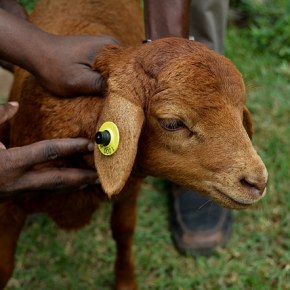
Kenya’s native goats and sheep, expertly crossbred, are key to helping farmers cope with climate change
Smallholder farmers and pastoral herders in East Africa are the target of an ongoing joint project of ILRI, the Jomo Kenyatta University of Agriculture and Technology (JKUAT) and the CGIAR Research Program on Climate Change, Agriculture and Food Security (CCAFS). Continue reading
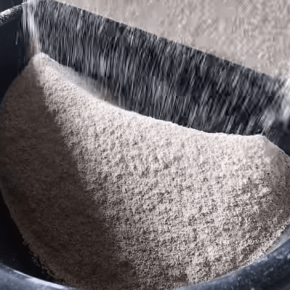
From food waste to animal feed, cassava peels potentially big business for Nigerian women
Existing technologies of drying and grading cassava peels could hold the key to providing a readily available and sustainable source of animal feeds, increasing incomes for women and boosting food security in West Africa. Continue reading
Livestock at Expo Milano 2015: Three initiatives for a more sustainable and equitable sector put their heads together
What follows are the key findings and conclusions of the workshop above, which was co-organized by the Swiss Federal Office for Agriculture, (FOAG), the Food and Agriculture Organization of the United Nations (FAO) and the International Livestock Research Institute (ILRI). Continue reading
Tackling climate change could be the greatest global health opportunity of the 21st century–The Lancet
The 2015 Lancet Commission on Health and Climate Change was been formed to map out the impacts of climate change and the necessary policy responses. The central finding from the Commission’s work is that tackling climate change could be the greatest global health opportunity of the 21st century. One of the authors of the paper is ILRI veterinary epidemiologist and food safety expert Delia Grace, of the International Livestock Research Institute (ILRI). Continue reading