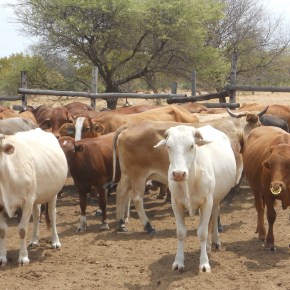
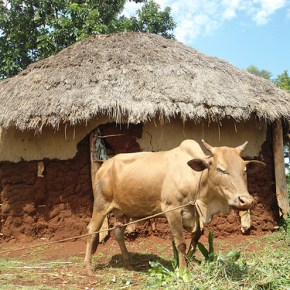
In the film, Faustina Akyoo, a small-scale dairy farmer, explains how she learnt dairying from her parents in Arusha before moving to the coastal town of Tanga where she continued keeping cows in addition to taking up employment. She is now retired, and her five dairy cows are an important source of income for her family. Continue reading
Category Archives: Countries
Realpolitik–Nairobi ‘Community of Practice’ communicators get real practice impacting policymakers
A community of practice for communications staff in research and development organizations (DevComms CoP) based in Nairobi participated in a ‘Science Communications for Policy Impact’ workshop following a conference, ‘Landscapes for People, Food and Nature’, at ICRAF on 3 July 2014. Continue reading
African talent feeding African markets with African products: Global food and agribusiness meeting hears of ‘livestock value chains’ in Africa
In Jun 2014 three agricultural economists working with the International Livestock Research Institute presented case studies at the World Forum of the International Food and Agribusiness Management Association (IFAMA) in Cape Town, South Africa. The main lesson from the two cases presented is that by training farmers, processors and other stakeholders supporting agribusiness development, African talent can create new products and innovative processes that help feed African markets with African products. Continue reading
ILRI-Tanzania country office opens in Dar es Salaam
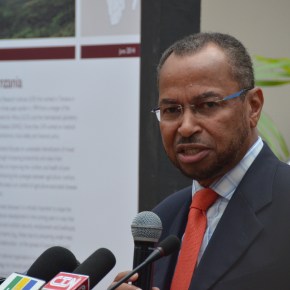
The Minister for Livestock and Fisheries Development in Tanzania, Hon Titus Mlengeya (MP) officially opened the ILRI-Tanzania country office on Friday 13 Jun 2014 in Dar es Salaam. Continue reading
Deadly strain of bird flu in China linked to live poultry markets; high-risk spots in Asia mapped–New study
A new study reveals conditions linked to the emergence and spread of deadly bird flu and maps the areas of Asia at greatest risk of the spread of the new virus strain. A dangerous strain of avian influenza, H7N9, that’s causing severe illness and deaths in China may be inhabiting a small fraction of its potential range and appears at risk of spreading to other suitable areas of India, Bangladesh, Vietnam, Indonesia and the Philippines, according to a new study published today in the journal Nature Communications. Continue reading
Assessing societal changes from changing dairy value chains in Sahelian pastoral communities
ILRI’s Jo Cadilhon introduces a method being tried out in Senegal to measure the social impacts of dairy supply chain innovation in pastoralist societies.
Continue reading
New UK funding for disease surveillance will improve health and farming in Kenya
The University of Liverpool has been given funding to start a surveillance program to reduce the incidence of diseases transmitted between people and livestock in western Kenya. The £3.6 million grant will train veterinary and medical technicians to monitor farms, markets and slaughterhouses. They will use a mobile data collection system to generate a comprehensive database of the prevalence and economic impact of these diseases. The information generated will be used to provide evidence for government health policy in the area. Continue reading
Getting (the band) back together: US climate report sees reconnecting crops to livestock as smart adaption strategy
The new National Climate Assessment released recently by President Obama’s Global Change Research Program contains dour predictions about the impact of climate change on livestock production in the United States. How can the country’s livestock sector adapt to these changes? One strategy suggested in the report will be familiar to experts at the International Livestock Research Institute (ILRI). It involves raising livestock and crops together and taking advantage of the synergies between the two. Continue reading
Aflatoxins in Kenya’s food chain: Overview of what researchers are doing to combat the threat to public health
Aflatoxins are toxic chemicals produced as by-products by fungi (moulds) that grow on maize, groundnuts and other food crops. These toxins also affect feedstuffs, which then contaminate milk, meat and eggs. The toxins occur everywhere in the world, but pose particularly high risks in tropical developing countries where certain staple foods, such as maize and sorghum, comprise a large part of the diets of the poor. Continue reading
Egyptian aquaculture: Farming tilapia, mullet and carp in the Nile Delta
Within the CGIAR Research Program on Livestock and Fish and embedded within a project on aquaculture development funded by the Swiss Agency for Development and Cooperation (SDC), IEIDEAS — ‘Improving Employment and Income through the Development of Egypt’s Aquaculture Sector’ — is a project implemented by CARE and WorldFish to secure a sustainable future for at least 100,000 people by upgrading Egypt’s aquaculture value chain. Continue reading