Robin Mbae, deputy director of livestock production at the Kenya Ministry of Agriculture, Livestock and Fisheries, describes Kenya’s planning and implementation of interventions to address the impacts of climate change on the livestock sector and vice versa. Continue reading
Category Archives: Dairying
India’s Odisha State and ILRI join forces to improve livestock feeding and mechanization
A three-year ILRI-Odisha State project, ‘Feed and Fodder Production in Different Agro-Climatic Zones and its Utilization for Livestock of Odisha,’ which is worth more than USD2 million (INR18.08 crore), will map feed and fodder supply and demand, improve feeding practices and build capacity of key players in the feed value chain in the state. Continue reading
Milk consumption project to tackle child malnutrition in Rwanda
A new ILRI-led Feed the Future Livestock Systems Innovations Lab (LSIL) project on ‘Enhancing milk quality and consumption for improved income and nutrition in Rwanda’ will contribute to efforts towards enhancing the quality and consumption of milk for improved income and nutrition in the country Continue reading
The hand that cares and feeds: India’s unnatural ‘natural’ caretakers of livestock
I was impressed by how much India’s women food producers make the most out of their situations, how often they thrive in what they do despite constraints, how few view themselves as victims of their circumstances, how often, and with what assurance and purposefulness, they exercise agency. Continue reading
India’s addiction to milk as a diabetes pandemic moves to the villages
This is the eleventh in a series of articles on ‘Curds and goats, lives and livelihoods—A dozen stories from northern and eastern India’. PART 11: India’s addiction to milk as a diabetes pandemic moves to the villages Continue reading
Odisha Odyssey: A look at the emerging commercial dairy value chains in eastern India
In recent years, ILRI scientists have been working with institutional partners and local farmer organizations in Odisha, a large eastern state of India on the Bay of Bengal, on research to improve the feed and fodder resources readily available to smallholder livestock keepers. ILRI conducted this collaborative research through a collaborative CGIAR Cereal Systems Initiative for South Asia (CSISA) aiming to increase and sustain small farm productivity in selected regions of Bangladesh, India and Nepal.
As part of an ILRI photojournalism trip to India undertaken in early Mar 2016, the authors visited a town on the outskirts of Bhadrak, a city in northern Odisha, to capture a bit of what the ILRI-led CSISA work has accomplished for small-scale dairy farmers in the area. Continue reading
Building better brands and lives through peri-urban dairying and smart crop-dairy farming
The fourth in a series of articles on ‘Curds and goats, lives and livelihoods—A dozen stories from northern and eastern India’.
PART 4: Culture of the cow: Curds of the village—Building better brands and lives through peri-urban dairying Continue reading
Culture of the cow: Curds in the city—Better living through smallholder dairying in northern India
This is the third in a series of articles on ‘Curds and goats, lives and livelihoods—A dozen stories from northern and eastern India’. Continue reading
Elite buffaloes and other exemplars of advanced Indian dairy science at the National Dairy Research Institute
Shrestha, a spirited buffalo bull, greeted Jimmy Smith, director general of the International Livestock Research Institute (ILRI), with a low grunt during a visit Smith and his delegation recently made at the National Dairy Research Institute (NDRI), India’s pre-eminent dairy research centre, located in the northern city of Karnal and the prosperous state of Haryana. Continue reading
Colourful convocation: Jimmy Smith addresses graduates of India’s prestigious National Dairy Research Institute
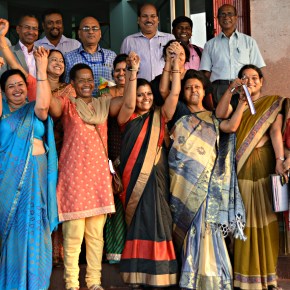
ILRI Director General Jimmy Smith was in Haryana, India, to give the convocation address (aka ‘the commencement speech’ in North America) at NDRI’s 14th graduation ceremony. Smith was also being awarded an honorary degree (honoris causa) for his contributions to livestock research for development. Continue reading