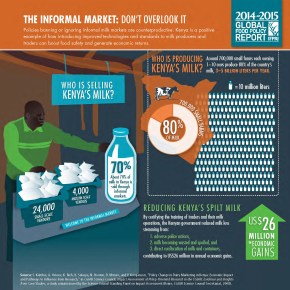
An interesting, if scary, read is chapter 6 of the recently launched flagship report of IFPRI on reducing and managing food scares, co-written by Delia Grace at ILRI and John McDermott, who directs the CGIAR Research Program on Agriculture for Nutrition and Health, led by IFPRI. Continue reading
Category Archives: Disease Control
Managing the most nutritious, and riskiest, foods in the informal markets of developing countries
A new book compiling 25 contemporary studies on food safety in Africa’s informal markets offers (surprising) lessons for much of the developing world. Continue reading
First global map of the rising use of antimicrobial drugs in farm animals published in PNAS
As reported last week in a scientific paper published in the Proceedings of the National Academy of Science (PNAS), Global trends in antimicrobial use in food animals, worldwide antimicrobial consumption is expected to rise by a staggering 67% between 2010 and 2030. Continue reading
Fighting fire with fire: New study shows co-parasitic infections of cattle protect the animals from lethal disease
A Boran calf and girl in eastern Kenya (photo credit: ILRI/Stevie Mann). A new study of the cattle killer East Coast fever finds a protective process that may also be at work in human malaria: Infections with milder parasites may protect against severe disease. African cattle infected with a lethal parasite that kills one million … Continue reading
Despite contamination concerns, Africa must embrace ‘wet markets’ as key to food security
A new compilation of 25 studies in Africa finds that informal markets provide essential sources of food and income for millions of poor, with milk and meat that is often safer than supermarkets. Misguided efforts to control the alarming burden of food-related illnesses in low-income countries risk intensifying malnutrition and poverty — while doing little to improve food safety. Blunt crack-downs on informal milk and meat sellers that are a critical source of food and income for millions of people are not the solution. Continue reading
Sam Black on Noel Murphy, Irish geneticist gentleman scholar
Noel Murphy died on Friday 16 January 2015, leaving the world devoid of a gentleman and scholar, and his friends and family bereft of a pillar of quiet strength, wisdom and thoughtfulness. Continue reading
One-for-all and all-for-one: Breaking down the walls between the livestock, health and environmental sectors
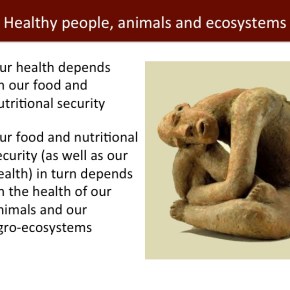
In case you missed it, here is the gist of a keynote presentation on ‘one-health’ made by Jimmy Smith, the director general of the International Livestock Research Institute (ILRI), at the 5th biennial conference of the International Association for Ecology & Health, held in Montreal, Canada, 11−15 Aug 2014. Smith’s presentation was titled: ‘Healthy people, animals and ecosystems for global food and nutritional security’. Continue reading
African Animal Annals: Deadly trifecta of climate change, population and disease?
All fine artwork on this page is by Olivia Pendergast (see note below for more information). In the last quarter of 2014 a book was published and launched on climate change and public health. Edited by Colin Butler, of the University of Canberra, and published by CABI, the book brings together 56 authors from 19 … Continue reading
UK animal health conference celebrates the lifeworks of immunologist Declan McKeever
Oct 2014 UK conference to celebrate the life’s work of Declan MKeever, former livestock immunologist at ILRAD and ILRI Continue reading
New map: Benefits of controlling trypanosomosis in the Horn of Africa
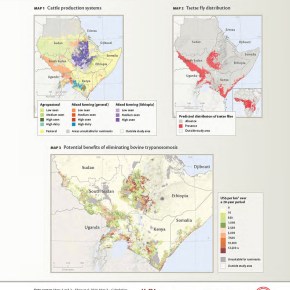
Using the Horn of Africa as an example, the maps illustrate different steps in a methodology developed to estimate and map the economic benefits to livestock keepers of controlling a disease (Shaw et al. 2014). Cattle are first assigned to different production systems as shown in Map 1, illustrating for example, where mixed farming is heavily dependent on the use of draft oxen in Ethiopia, areas of Sudan and South Sudan where oxen use is much lower, and the strictly pastoral areas of Somalia and Kenya. Continue reading