Food research organizations say sustainable small-scale livestock farming is essential to meeting the 21st-century’s protein needs. Continue reading
Category Archives: Food Security
When ‘Do no harm’ is harder than ‘doing good’
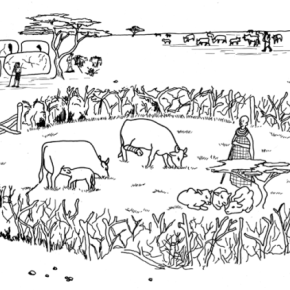
Agricultural researchers working to enhance traditional pasture conservation by Tanzania’s pastoral Maasai communities are systematically addressing gendered norms and roles to ensure that they don’t end up hurting more than helping these communities. Continue reading
Livestock-enhanced diets in the first 1,000 days of life: Pathways to better futures in low-income countries
A new report was published this month on the value of ensuring consumption of meat, milk and eggs by infants up to two years of age and by expectant and new mothers in developing countries (the first 1,000 days). The report was published by ILRI and the Chatham House Centre on Global Health Security. Highlights of the findings of this joint ILRI-Chatham livestock study were presented at a side event at the EAT Stockholm Food Forum on 11 Jun 2018. Continue reading
Can livestock-enhanced diets of the poor in the first 1,000 days of life lead to healthy and sustainable futures?
This year’s EAT 2018 Stockholm Food Forum (11–12 Jun 2018) explores ways to achieve healthy and sustainable diets for a growing global population. On Monday, 11 Jun 2018, Chatham House and ILRI will host a side event around the findings of an evidence review on the influence of livestock-derived foods—meat, milk and eggs—on the nutrition of women and of children during their first 1,000 days of life, from conception to age two. Continue reading
Why milk, meat and eggs can make a big difference to the world’s most nutritionally vulnerable people
Opinion piece by ILRI scientist Silvia Alonso on the ILRI-Chatham House report on the importance of livestock-derived foods in the first 1,000 days of life. Continue reading
Meat, milk, eggs can make a big difference in the first 1,000 days of life in low-income countries—New report
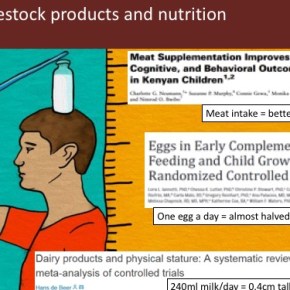
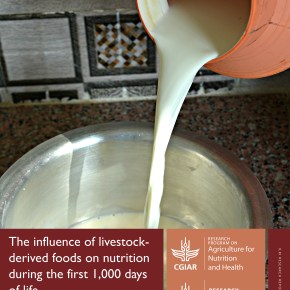
An extensive review of research found demonstrable nutritional benefits of providing children, particularly in countries in Africa and South Asia where undernutrition is highest, with livestock-derived foods such as meat, milk and eggs. Consumption of livestock-derived foods was typically found to be very low among poor families in those countries. The influence of livestock-derived foods on nutrition during the first 1,000 days of life, published by the International Livestock Research Institute (ILRI) and Chatham House, also concluded that it was possible to meet the nutritional needs of the most vulnerable through livestock-derived produce even if total global livestock production slowed down. Continue reading
Kenyan President Kenyatta headlines national conference at ILRI Nairobi on innovations in Kenya’s agricultural sector
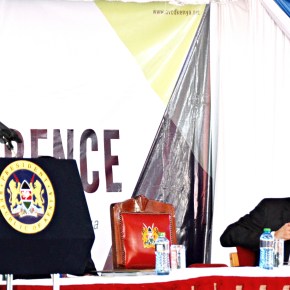
Kenya President Uhuru Kenyatta addressed the 400 guests at the national conference of the Feed the Future Kenya Accelerating Value Chain Development project at ILRI on 27 Apr 2018. Continue reading
Art and science bring poultry genetics to life in Ethiopia while celebrating local diversity in all its forms
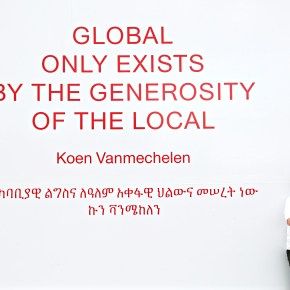
Art and science unite to serve Ethiopian farmers—’Incubated Worlds’ explores genetic diversity of poultry to boost nutrition and incomes. Continue reading
Ethiopia sets out the futures for its growing poultry, dairy and meat subsectors
A new livestock sector analysis from the Ethiopia’s Livestock State Ministry (LSM) and Ministry of Livestock and Fisheries (MoLF) and the International Livestock Research Institute (ILRI) was recently published. This work was funded by the Bill & Melinda Gates Foundation (BMGF) to help Ethiopia in its fact-based planning. Continue reading
Shirley Tarawali on convergence in consumption of milk, meat, eggs at the Global Forum for Food and Agriculture
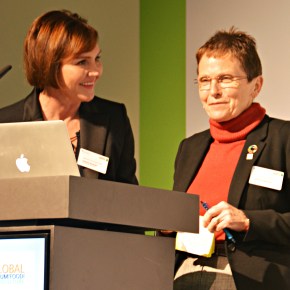
Shirley Tarawali’s keynote presentation at a GFFA expert panel session focused on Food of animal origin: Demand and diversity. She said that global demand for livestock-derived foods is changing both in quantities—with demand flattening in rich countries but increasing in low- and middle-income countries—and in qualities, varying by region and commodity, and that meeting that rising demand for livestock-derived foods ‘sustainably, responsibly and efficiently’ requires two main things—(1) moderating the demand, wasting less, producing more and improving production efficiency while also (2) taking account of the diversity of livestock systems and producers to maximize opportunities to address the United Nation’s 17 Sustainable Development Goals. Continue reading