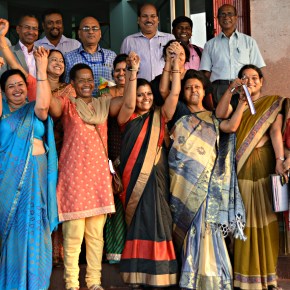
Andrew Mude, an economist and principal scientist at ILRI, is being presented with the 2016 Norman Borlaug Award for Field Research and Application today, 12 Oct 2016, for his work leading an innovative livestock insurance program that employs satellite data to help protect livestock herding communities in the Horn of Africa from the devastating effects of drought. Continue reading

Category Archives: Livelihoods
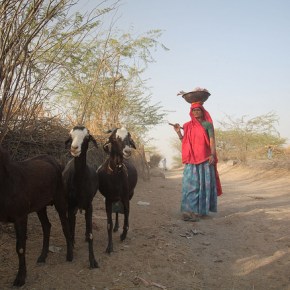
The hand that cares and feeds: India’s unnatural ‘natural’ caretakers of livestock
I was impressed by how much India’s women food producers make the most out of their situations, how often they thrive in what they do despite constraints, how few view themselves as victims of their circumstances, how often, and with what assurance and purposefulness, they exercise agency. Continue reading
DID YOU KNOW? ILRI in the Livestock Global Alliance
The following remarks were made by Shirley Tarawali, assistant director general of the International Livestock Research Institute (ILRI) on 26 May 2016 at a side event held at the General Assembly of the World Organisation for Animal Health, in Paris, where an alliance of leading organizations in global livestock issues launched an advocacy brief and related materials. Continue reading
Odisha Odyssey: A look at the emerging commercial dairy value chains in eastern India
In recent years, ILRI scientists have been working with institutional partners and local farmer organizations in Odisha, a large eastern state of India on the Bay of Bengal, on research to improve the feed and fodder resources readily available to smallholder livestock keepers. ILRI conducted this collaborative research through a collaborative CGIAR Cereal Systems Initiative for South Asia (CSISA) aiming to increase and sustain small farm productivity in selected regions of Bangladesh, India and Nepal.
As part of an ILRI photojournalism trip to India undertaken in early Mar 2016, the authors visited a town on the outskirts of Bhadrak, a city in northern Odisha, to capture a bit of what the ILRI-led CSISA work has accomplished for small-scale dairy farmers in the area. Continue reading
2016 Science Forum: Rethinking agricultural pathways to inclusive development
In the lead up to the 2016 Science Forum, steering committee members and invited speakers answered a few questions related to the Forum’s focus on agricultural research pathways to inclusive rural development. Below are excerpts of their responses. You’ll find all the responses on the SF2016 blog site. Continue reading
Building better brands and lives through peri-urban dairying and smart crop-dairy farming
The fourth in a series of articles on ‘Curds and goats, lives and livelihoods—A dozen stories from northern and eastern India’.
PART 4: Culture of the cow: Curds of the village—Building better brands and lives through peri-urban dairying Continue reading
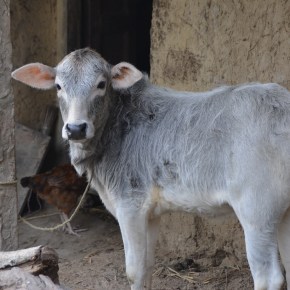
Culture of the cow: Curds in the city—Better living through smallholder dairying in northern India
This is the third in a series of articles on ‘Curds and goats, lives and livelihoods—A dozen stories from northern and eastern India’. Continue reading
Harnessing livestock for the Sustainable Development Goals
One of the fastest growing subsectors in agriculture–livestock–can significantly contribute to the United Nations’ Sustainable Development Goals (SDGs) if the opportunities it offers, especially for people in developing countries, are harnessed for economic growth, improved livelihoods and food and nutritional security. Continue reading
Livestock and the Sustainable Development Goals
CGIAR livestock scientists are working actively to help the world meet the SDGs. We are intentionally tailoring our livestock-related knowledge products, technologies, institutional arrangements and policy support to provide new options for meeting specific SDGs by addressing developing world livestock problems and opportunities. Continue reading
Vaccination proclamation: India protects the neglected ’living assets’ of its remote pig farmers
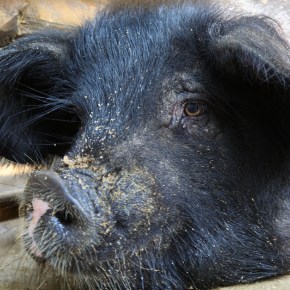
ILRI research to better control classical swine fever, also called hog cholera and pig plague, a highly contagious viral disease of pigs of all ages, usually killing the animals within two weeks of infection. The disease is endemic in the states of northeast India, where pig husbandry and meat eating are ubiquitous among the tribal communities that inhabit this remote region, isolated from the rest of India except through a slender corridor flanked by foreign territories. This article, one of a series being posted on the ILRI News blog, is one of 21 stories published in the ILRI Corporate Report 2014–2015, which you’ll find here: http://hdl.handle.net/10568/68631 Continue reading