Jimmy Smith, the director general of the International Livestock Research Institute (ILRI), is in London today (5 Oct 2017), speaking at an Extinction and Livestock Conference organized by Compassion in World Farming and the World Wildlife Fund. Continue reading
Category Archives: Story Type
Sense of an ending—Imperatives for delivering research with the (SDGs) end in mind
Speaking last week at the opening of the annual meeting of the Centre for Tropical Livestock Genetics and Health (CTLGH), ILRI Director General Jimmy Smith reminded his scientific audience of the specific livestock means by which the world can meet their ambitious goals. The four livestock development pathways Smith describes for meeting the SDGs—economic growth, equitable livelihoods, nutrition and health, ecosystem health—(see below) are largely unknown outside of the South, where they are taken for granted. Time for that to change, Smith said. Time for livestock researchers to conduct their science ‘with the end in mind’. Continue reading
Closer, smarter integration of crops, animals and soils has bolstered food security, livelihoods and incomes in rural Zimbabwe
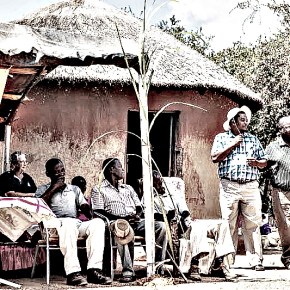
Partners and funders of a research-for-development project in rural Zimbabwe called ‘ZimCLIFS’ yesterday (18 Sep 2017) convened in the capital, Harare, to take stock of how small-scale mixed crop-and-livestock farmers improved their food and nutritional security and their livelihoods in four main districts (Goromonzi, Murewa, Gwanda and Nkayi, from 2012 to 2017) and in two spillover districts (Mutoko and Uzumba, from 2015 to 2017). Continue reading
Largest-ever micro-insurance payout made to Ethiopian pastoralists
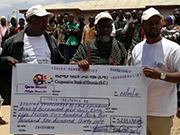
More than 2,250 pastoralists received insurance payouts following the extremely poor rains this year in southern Ethiopia. Low levels of rainfall have led to the loss of approximately 300,000 livestock in 2017 in the Borana zone of the southern Oromia region. The insurance payouts of more than ETB5.233 million (USD220,000) was the largest-ever micro-insurance indemnity made in Ethiopia. Each insured pastoralist received an average of ETB2,255 (USD96), which will allow the herders to purchase feeds for their surviving animals and to restock their herds. Continue reading
Hanoi workshop held on providing safer pork products in Vietnam
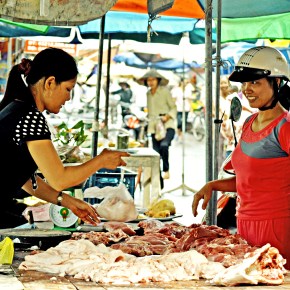
A two-day workshop, 7–8 Sep 2017, on the topic of ‘Improving food safety along the pork value chain—lessons learned and ways forward’. The workshop consisted of two parts: (1) the closing of a project on ‘Reducing disease risks and improving food safety in smallholder pig value chains in Vietnam’, known as PigRISK, and (2) the launching of a project on ‘Market-based approaches to improving the safety of pork in Vietnam’, known as SafePORK Continue reading
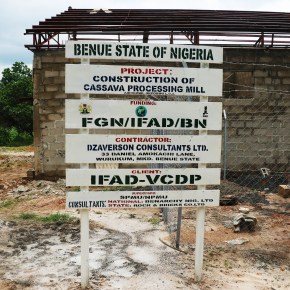
New factories in Nigeria transform cassava peels into livestock feed, creating jobs and incomes for women
A delegation comprising IFAD staff visited the Value Chain Development Programme (VCDP) cassava processing sites at Lokongoma, Wushishi (Niger State) and Idogodo, Okpokwu (Benue State) in late July, 2017 to discuss progress with this important project. Continue reading
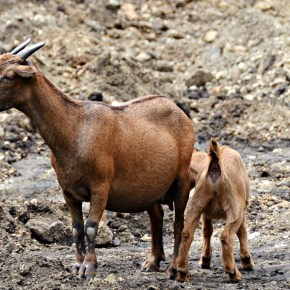
Lifetime performance of West African dwarf goats under different feeding systems
An article in ‘Animal’ compares the lifetime performance (mortality, maturity, nutrition, birth weight etc.) of West African Dwarf goats kept under various feeding systems. Continue reading
On what (and how and when) to measure when measuring impacts of agricultural research for development
By ILRI’s Iain Wright: On 6–8 Jul 2017, I attended a conference at ICRAF on Impacts of International Agricultural Research: Rigorous Evidence for Policy organized jointly by the CGIAR ISPC’s SPIA and PIM. I welcomed the delegates at this meeting in Nairobi, Kenya, on behalf of ICRAF and the International Livestock Research Institute (ILRI), the two CGIAR centres headquartered in Nairobi. A modified version of my address and personal reflections on impact assessment in CGIAR follows. Continue reading
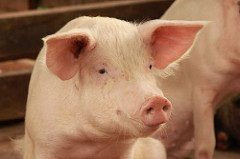
Pig farmers to earn more through new genetics project in Uganda
A newly launched pig genetics project seeks to increase the productivity and profitability of the Ugandan smallholder pig enterprises by developing a genetic improvement strategy to ensure the availability and accessibility of appropriate pig breeds. Continue reading
Why livestock are essential for Agenda 2030—Jimmy Smith at the High-Level Forum on Sustainable Development
United Nations High-Level Forum on Sustainable Development, Special Event: The Role of Livestock in Achieving the SDGs,Friday, 14 July, 2017: Opening remarks by Jimmy Smith, director general of the International Livestock Research Institute (ILRI) Continue reading