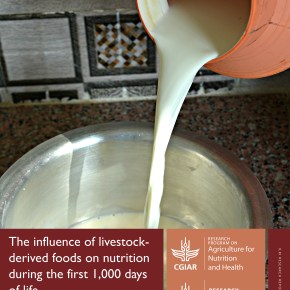
Opinion piece by ILRI scientist Silvia Alonso on the ILRI-Chatham House report on the importance of livestock-derived foods in the first 1,000 days of life. Continue reading
Category Archives: CRPs
Meat, milk, eggs can make a big difference in the first 1,000 days of life in low-income countries—New report
An extensive review of research found demonstrable nutritional benefits of providing children, particularly in countries in Africa and South Asia where undernutrition is highest, with livestock-derived foods such as meat, milk and eggs. Consumption of livestock-derived foods was typically found to be very low among poor families in those countries. The influence of livestock-derived foods on nutrition during the first 1,000 days of life, published by the International Livestock Research Institute (ILRI) and Chatham House, also concluded that it was possible to meet the nutritional needs of the most vulnerable through livestock-derived produce even if total global livestock production slowed down. Continue reading
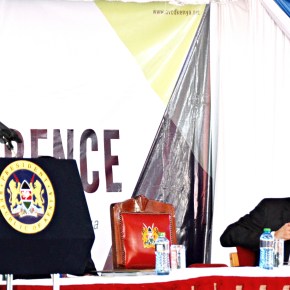
Kenyan President Kenyatta headlines national conference at ILRI Nairobi on innovations in Kenya’s agricultural sector
Kenya President Uhuru Kenyatta addressed the 400 guests at the national conference of the Feed the Future Kenya Accelerating Value Chain Development project at ILRI on 27 Apr 2018. Continue reading
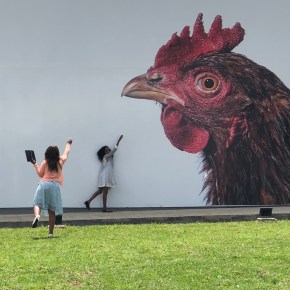
Art underlines the precious value of poultry genetic research
‘The Incubated Worlds art exhibition clearly communicates the importance of poultry production, genetic diversity and the interdependence of communities worldwide. The facility will be more than a place of research, but also of learning and innovation for farmers, poultry businesses, associations, cooperatives and communities’, said Siboniso Moyo, the ILRI director general’s representative in Ethiopia. Continue reading
Art and science bring poultry genetics to life in Ethiopia while celebrating local diversity in all its forms
Art and science unite to serve Ethiopian farmers—’Incubated Worlds’ explores genetic diversity of poultry to boost nutrition and incomes. Continue reading
On the need for expanding sustainability frameworks and veterinary vision in developing countries
A new science paper argues for broadening traditional approaches to livestock sustainability and veterinary vision in developing countries. Two of the three livestock science authors—Brian Perry and Tim Robinson—have formerly worked at the International Livestock Research Institute (ILRI) while the third—Delia Grace—co-leads ILRI’s Animal and Human Health program. Continue reading
Ethiopia sets out the futures for its growing poultry, dairy and meat subsectors
A new livestock sector analysis from the Ethiopia’s Livestock State Ministry (LSM) and Ministry of Livestock and Fisheries (MoLF) and the International Livestock Research Institute (ILRI) was recently published. This work was funded by the Bill & Melinda Gates Foundation (BMGF) to help Ethiopia in its fact-based planning. Continue reading
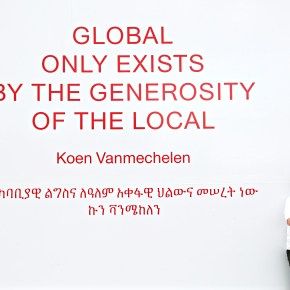
New advanced poultry facility combines art and science to boost nutrition and incomes in Ethiopia
On 26 April 2018, the International Livestock Research Institute (ILRI) and partner scientists and government officials join forces with Belgian artist Koen Vanmechelen to launch the research facility and art installation, Incubated Worlds, a unique combination of art and science that aims to improve nutrition and incomes in East Africa with disease-resistant, climate-resilient poultry. Continue reading
Empowering ruminant livestock enterprises in Mali—A Feed the Future-ILRI project
What happened in the Feed the Future Mali Livestock Technology Scaling Program (FTF-MLTSP) in early 2018? Open Day and stakeholder consultation for the program, PPR vaccine deployment, and market monitoring. Continue reading
Cereal straws and stovers for sustainable livestock futures: When crop biomass becomes livestock gold
Michael Blümmel, deputy program leader for the Feed and Forage Development program at ILRI, is lead author on a new paper that explores the big benefits of treating cereal straws and stovers—the ‘residues’ of cereal crops after their grain has been harvested—to release their sugars, thereby turning these crop residues into nourishing feed for ruminant farm animals—cows, water buffaloes, goats and sheep. Continue reading