A new study offers novel insights into rapid genomic adaptations to extreme environments in sheep and other animals and provides a valuable resource for future research on livestock breeding in response to climate change. Continue reading
Category Archives: Regions
‘Leveling’ livestock information: Knowledge management at an ICAR–ILRI communications workshop
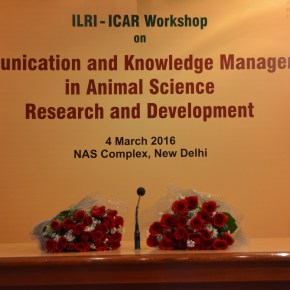
To share best practices and explore opportunities for collaboration, the International Livestock Research Institute (ILRI) and the Indian Council of Agricultural Research (ICAR) held a joint communications and knowledge management workshop on 4 Mar 2016 at the National Agricultural Science Centre Complex in New Delhi, India. Continue reading
Reaching stakeholders, influencing policies: ICAR–ILRI communications workshop
A communications workshop co-sponsored by the International Livestock Research Institute (ILRI) and the Indian Council of Agricultural Research (ICAR) was held on 4 March 2016 in New Delhi, India. This is the second of three reports on the workshop. Continue reading
Kenyan cattle found to have much smaller faecal carbon footprints than those used in climate change inventories
Greenhouse gases emitted by Kenyan cattle excreta are found to be much lower than estimates derived from models in industrialized countries. Continue reading
Vaccine research on Africa’s cattle-killing East Coast fever: A short (somewhat potted but handsomely illustrated) history
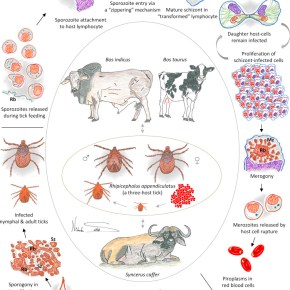
Tremendous research progress has been made over the last ten years to better control the deadly African disease of cattle known as East Coast fever. This disease is caused by a single-celled organism, Theileria parva, which is carried by some tick species. Cattle become infected when a tick carrying the parasite takes a blood-meal from the animal over several days. Continue reading
Getting the (science) word out: ILRI and ICAR share livestock communications and knowledge management practices
The International Livestock Research Institute (ILRI) and the Indian Council of Agricultural Research (ICAR) held a one-day joint communications and knowledge management workshop on 4 Mar 2016 at the prestigious and spacious National Agricultural Science Centre Complex, in New Delhi, India. Continue reading
Odisha Odyssey: A look at the emerging commercial dairy value chains in eastern India
In recent years, ILRI scientists have been working with institutional partners and local farmer organizations in Odisha, a large eastern state of India on the Bay of Bengal, on research to improve the feed and fodder resources readily available to smallholder livestock keepers. ILRI conducted this collaborative research through a collaborative CGIAR Cereal Systems Initiative for South Asia (CSISA) aiming to increase and sustain small farm productivity in selected regions of Bangladesh, India and Nepal.
As part of an ILRI photojournalism trip to India undertaken in early Mar 2016, the authors visited a town on the outskirts of Bhadrak, a city in northern Odisha, to capture a bit of what the ILRI-led CSISA work has accomplished for small-scale dairy farmers in the area. Continue reading
Odisha Odyssey: The Arcadian landscapes and tribal goat keepers of Mayurbhanj
Note: This is the sixth in a series of articles on ‘Curds and goats, lives and livelihoods—A dozen stories from northern and eastern India’.
PART 6: Odisha Odyssey: The Arcadian landscapes and tribal goat keepers of Mayurbhanj Continue reading
‘Wonder Women’ of Bhubaneswar
Temple carving in Bhubaneswar (this and all photos on this page by ILRI/Susan MacMillan). Note: This is the fifth in a series of articles on ‘Curds and goats, lives and livelihoods— A dozen stories from northern and eastern India’. PART 5: The ‘Wonder Women’ of Bhubaneswar By Susan MacMillan, of the International Livestock Research Institute (ILRI) … Continue reading
‘One Health for the Real World’ (or, ‘real livestock for real global wellbeing’)
Twenty organizations, including ILRI, made up the Dynamic Drivers of Disease in Africa Consortium, which from 2012 to 2015 coordinated research exploring the relations among African ecosystems and zoonotic diseases—those transmitted between animals and people—that impinge on ecosystem, human and animal wellbeing. Continue reading