A two-day workshop, 7–8 Sep 2017, on the topic of ‘Improving food safety along the pork value chain—lessons learned and ways forward’. The workshop consisted of two parts: (1) the closing of a project on ‘Reducing disease risks and improving food safety in smallholder pig value chains in Vietnam’, known as PigRISK, and (2) the launching of a project on ‘Market-based approaches to improving the safety of pork in Vietnam’, known as SafePORK Continue reading
Category Archives: AHH
Animal and Human Health program
Following the vaccine that wiped out rinderpest, a new vaccine against sheep and goat plague proves promising
A new paper by researchers at ILRI describes development of an effective experimental and thermostable vaccine against ‘peste des petits ruminants’, or PPR for short, a disease more commonly known as sheep and goat plague. Continue reading
Six new papers on the ancient, complex and everlasting farm animal–zoonotic disease–human well-being nexus
Six new high-level publications by scientists and partners of the International Livestock Research Institute (ILRI) and the CGIAR Research Program on Agriculture for Nutrition and Health (A4NH) on zoonoses, livestock and well-being. Continue reading
Lessons learnt out of Africa: 19 factors not to underestimate in rural livestock/agricultural research for development
Robyn Alders gave a particularly candid and interesting presentation at a seminar/webinar held on 4 May 2017 at ILRI on the subject of ‘Animal-source foods for nutrition impact: Evidence and good practices for informed project design’. This was the fourth in a Livestock and Household Nutrition Learning Series of seminars/webinars organized jointly by Land O’Lakes International Development and ILRI. Continue reading
Livestock for food security and nutrition—Committee on World Food Security policy recommendations
The following policy recommendations build on the main findings of the CFS High Level Panel of Expert’s Jul 2016 report #10, on Sustainable agricultural development for food security and nutrition: What roles for livestock? The sustainable development of agriculture, including livestock, is essential for poverty reduction and the achievement of food security and nutrition. Continue reading
Vietnam launches report on better managing risks to food safety
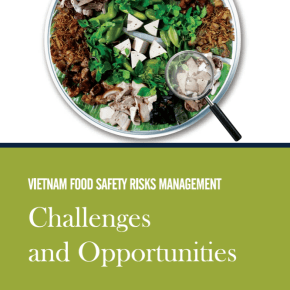
A report launched this week on managing risks to food safety in Vietnam was prepared by the World Bank and other research and development partners at the request of the Government of Vietnam. The International Livestock Research Institute (ILRI) was the lead technical partner in development of the report. Food Safety Risk Management in Vietnam: Challenges and opportunities was launched on 27 Mar 2017. Continue reading
Uganda research-for-development work is helping to transform the country’s growing smallholder pig sector
The focus of the government of Uganda is to transform agriculture from subsistence to commercially oriented systems. The work being done by ILRI resonates with government’s objectives Continue reading
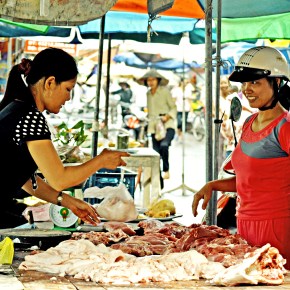
A deep dive inside Vietnam’s pork foodshed to determine food safety issues and their practical resolutions
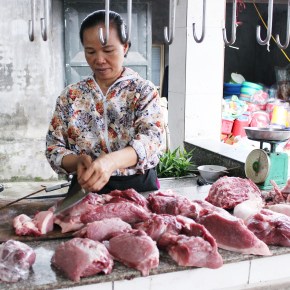
Pork meat sold in Vietnam has been found by researchers to commonly carry bacteria that could cause disease—but they also found that the risk of that meat sickening people is largely reduced due to the Vietnamese habit of buying very fresh meat and cooking it shortly thereafter. The research results indicate ways that the safety of pork meat can be even further improved in this fast-growing and -evolving market. The bottom line is that ensuring safe pork consumption in Vietnam is very important—and very doable. Continue reading
Livestock and human health – highlights from ILRI’s corporate report 2015–2016
The experience of the International Livestock Research Institute (ILRI) and partner scientists in 2015–2016 unmistakably identifies the potential benefits to smallholder farmers and consumers of research into livestock and human health. Smallholder farmers could potentially save hundreds of millions of US dollars annually, following breakthroughs in the development of vaccines for contagious bovine pleuropneumonia and Rift Valley fever, the latter posing a serious threat to human as well as animals. However, it was the participation in high-level fora and implementation strategies which are likely to deliver the rapid life changes for smallholder farmers on the ground. Continue reading
Making livestock foods safe—Lessons from Vietnam on what works—and what doesn’t
The experiences of developed countries, which now have relatively safe food, is that command-and-control approaches to food safety, which rely mainly on inspection and punishment, are less effective than approaches in which stakeholders are empowered and encouraged to self-regulate, motivated by the realisation that this is more profitable in the long term. Continue reading