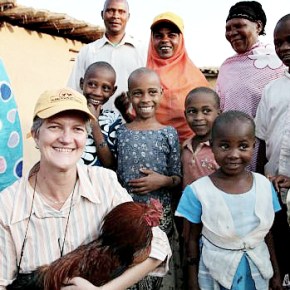
Robyn Alders gave a particularly candid and interesting presentation at a seminar/webinar held on 4 May 2017 at ILRI on the subject of ‘Animal-source foods for nutrition impact: Evidence and good practices for informed project design’. This was the fourth in a Livestock and Household Nutrition Learning Series of seminars/webinars organized jointly by Land O’Lakes International Development and ILRI. Continue reading
Category Archives: Species
Uganda research-for-development work is helping to transform the country’s growing smallholder pig sector
The focus of the government of Uganda is to transform agriculture from subsistence to commercially oriented systems. The work being done by ILRI resonates with government’s objectives Continue reading
A deep dive inside Vietnam’s pork foodshed to determine food safety issues and their practical resolutions
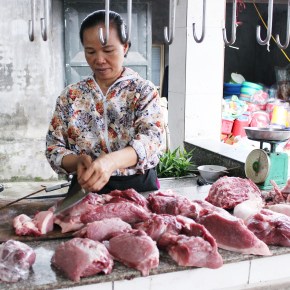
Pork meat sold in Vietnam has been found by researchers to commonly carry bacteria that could cause disease—but they also found that the risk of that meat sickening people is largely reduced due to the Vietnamese habit of buying very fresh meat and cooking it shortly thereafter. The research results indicate ways that the safety of pork meat can be even further improved in this fast-growing and -evolving market. The bottom line is that ensuring safe pork consumption in Vietnam is very important—and very doable. Continue reading
Beef value chain actors reap big gains from new financing in Southern Africa
Efforts by research and development partners are offering renewed hope for livestock financing in Southern Africa. This was revealed at an International Conference on Livestock Value Chain Finance and Access to Credit, organized by the International Livestock Research Institute (ILRI) in partnership with the Swaziland Water and Agricultural Development Enterprise (SWADE) and Swaziland’s Micro Finance Unit (MFU) 21-23 Feb 2017. Continue reading
Making livestock foods safe—Lessons from Vietnam on what works—and what doesn’t
The experiences of developed countries, which now have relatively safe food, is that command-and-control approaches to food safety, which rely mainly on inspection and punishment, are less effective than approaches in which stakeholders are empowered and encouraged to self-regulate, motivated by the realisation that this is more profitable in the long term. Continue reading
Record payouts being made by Kenya Government and insurers to protect herders facing historic drought
More than Ksh214 million is on tap for 12,000 pastoral households in six counties of northern Kenya through innovative policies that use satellite imagery to trigger payments for feed, veterinary supplies and water. Continue reading
Kenya’s wildlife populations are in ‘widespread’ and ‘catastrophic’ decline—New study
Here’s a wake up call for all those who care about Kenya’s rich heritage of wild animals, rangelands and pastoral peoples. A new study reporting on the period from 1977 to 2016 says wildlife on the rangelands of Kenya, which still support some of the richest herds of mammals on earth, is in precipitous decline while populations of goats and sheep are increasingly sharply. Continue reading
India and Vietnam in South-South collaboration on shared pig breeds, production systems and cultures
Nagaland launches a comprehensive state pig-breeding policy, the first of its kind in India, developed through participatory and consultative processes. Continue reading
Cloned bull could contribute to development of disease-resistant African cattle
A note in a scientific journal gives an update on long-term research to develop African cattle resistant to the Africa animal disease known as trypanosomiasis. The aim of this research is to help reduce widespread poverty and hunger on the continent by improving livestock livelihoods. Continue reading
The hand that cares and feeds: India’s unnatural ‘natural’ caretakers of livestock
I was impressed by how much India’s women food producers make the most out of their situations, how often they thrive in what they do despite constraints, how few view themselves as victims of their circumstances, how often, and with what assurance and purposefulness, they exercise agency. Continue reading