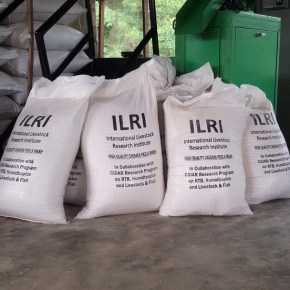
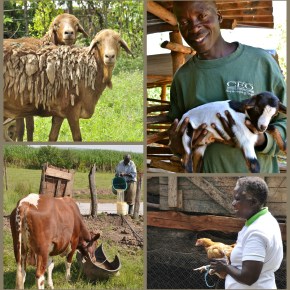
Farmers participating in the Zimbabwe Crop-Livestock Integration for Food Security (ZimCLIFS) project have increased their gross margins by up to 70%. The ongoing food security improvement project is targeting the country’s dairy farmers to help improve feed farming and overall dairy production. Continue reading
Category Archives: CRPs
A couple of ‘missings’ for the Paris climate talks
In the days leading up to the start of the climate change talks in Paris (COP21) this week (30 Nov–11 Dec 2015), we at the International Livestock Research Institute (ILRI) have been busy responding to recent articles in the press advocating that ‘the world’ eat less meat to reduce greenhouse gases and other livestock ‘bads’. … Continue reading
Processing African cassava peels, potentially a billion dollar business
With livestock production expected to more than double in the next 40 years, transforming cassava peels into high quality feed holds huge potential for African economies struggling to meet rapidly rising demand for animal-source products, according to research proposal recently published by three CGIAR centres. Continue reading
Climate-smart livestock farming in developing countries is boosted by a £10-million research award
Researchers at the Roslin Institute will be using funds from the Bill & Melinda Gates Foundation to investigate how genetic information can improve the health and productivity of farmed animals in tropical climates, which is a proven approach to climate change mitigation and adaptation. The Centre for Tropical Livestock Genetics and Health is an alliance between the Institute at the University of Edinburgh, Scotland’s Rural College (SRUC) and the Africa-headquartered International Livestock Research Institute (ILRI). The partner institutions are making additional contributions with a value of £10 million to support the initiative over the next five years. Continue reading
Roots, tubers and banana plants: Next-generation pig feeds for Uganda
The authors call for further exploration of strategies to conserve root, tuber and banana crop residues during the harvest period to reduce waste and improve incomes for smallholder pig farmers in Uganda. Continue reading
Aflatoxin levels in cow milk and feed in the Addis Ababa milk shed—New study
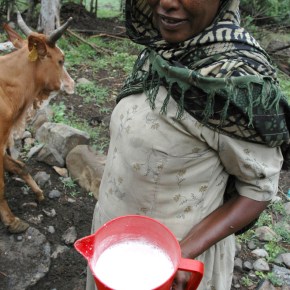
Ethiopian farmer with fresh milk from her cow (photo credit: ILRI/Apollo Habtamu). This article is written by ILRI scientists Dawit Gizachew, Barbara Szonyi, Azage Tegegne, Jean Hanson and Delia Grace Editor’s note: A statement in the article below, comparing various levels of risk, offended some of our readers. We thank those readers who let us … Continue reading
The sharp divide: Do we need animals to feed this world?
Livestock, the fastest-growing, highest-value and a highly controversial agriculture sector, is at a crossroads. Following a new set of 17 sustainable development goals, the current and potential roles of livestock systems in food and nutrition security and other aspects of sustainable development, including the environment, human health and livelihoods, continue to be debated. Opinions are sharply divided in the industrialized world between those who consider animals to be more part of the solution and those who consider them to be more part of the problem. Continue reading
Mixing it up—The information ‘black hole’ on crop+animal recipes for climate-smart and climate-resilient farms
We are unaware of any comprehensive studies undertaken in sub-Saharan Africa to explore how mixed farms will be affected by climate change and the cost and benefits of different adaptation options. Underestimating the importance of livestock in the mixed’ smallholder farming systems that are ubiquitous across the developing world weakens both emissions reduction and climate change adaptation efforts. Continue reading
New DNA analysis of Asian sheep reveals unique diversity crucial to contemporary food and climate concerns
At a time when the price of mutton is climbing and wool crashing, a groundbreaking new study has used advanced genetic sequencing technology to rewrite the history of sheep breeding and trading along the ancient Silk Road—insights that can help contemporary herders in developing countries preserve or recover valuable traits crucial to their food and economic security. The new findings regarding one of the first animals ever domesticated will be published in the October print edition of the journal Molecular Biology and Evolution. They are the product of an unprecedented collaboration involving scientists in China, Iran, Pakistan, Indonesia, Nepal, Finland, and the United Kingdom. The team analysed the complete mitochondrial DNA of 42 domesticated native sheep breeds from Azerbaijan, Moldova, Serbia, Ukraine, Russia, Kazakhstan, Poland, Finland, China and the United Kingdom, along with two wild sheep species from Kazakhstan. Continue reading
New study recommends continued research on the possible role pigs could play in transmitting Ebola in Uganda
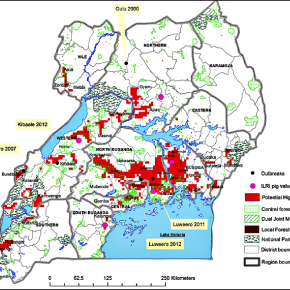
A new risk assessment paper, Assessing the potential role of pigs in the epidemiology of the Ebola virus in Uganda, was published in the science journal Transboundary and Emerging Diseases on 27 Aug 2015. The authors are scientists at the International Livestock Research Institute (ILRI). Presently, there is no solid evidence that pigs have any role in the past outbreaks of Ebola virus disease. But the risk assessment paper indicates that further research on the role pigs may play in Ebola virus transmission in Uganda is warranted. Continue reading