Shrestha, a spirited buffalo bull, greeted Jimmy Smith, director general of the International Livestock Research Institute (ILRI), with a low grunt during a visit Smith and his delegation recently made at the National Dairy Research Institute (NDRI), India’s pre-eminent dairy research centre, located in the northern city of Karnal and the prosperous state of Haryana. Continue reading
Category Archives: Cattle
Fragments d’ILRI: Le plan directeur pour l’élevage en Ethiopie devrait aider 2.36 millions de ménages à sortir de la pauvreté
Depuis 20 ans, le gouvernement éthiopien compte sur une réelle transformation du secteur agricole, mais l’absence d’un plan directeur en a retardé la mise en œuvre. Cependant un nouveau projet de recherche interdisciplinaire, que Barry Shapiro – chercheur à l’Institut International pour la Recherche sur l’Elevage (ILRI) – a présenté au Ministère de l’Agriculture (MdA) à Addis Abeba, révèle les bénéfices potentiels d’un Plan Directeur pour l’Elevage (PDE, LMP en anglais) en Ethiopie. Continue reading
No longer business as usual: Improved feeds transforming dairying in Zimbabwe
Farmers participating in the Zimbabwe Crop-Livestock Integration for Food Security (ZimCLIFS) project have increased their gross margins by up to 70%. The ongoing food security improvement project is targeting the country’s dairy farmers to help improve feed farming and overall dairy production. Continue reading
Climate-smart livestock farming in developing countries is boosted by a £10-million research award
Researchers at the Roslin Institute will be using funds from the Bill & Melinda Gates Foundation to investigate how genetic information can improve the health and productivity of farmed animals in tropical climates, which is a proven approach to climate change mitigation and adaptation. The Centre for Tropical Livestock Genetics and Health is an alliance between the Institute at the University of Edinburgh, Scotland’s Rural College (SRUC) and the Africa-headquartered International Livestock Research Institute (ILRI). The partner institutions are making additional contributions with a value of £10 million to support the initiative over the next five years. Continue reading
Aflatoxin levels in cow milk and feed in the Addis Ababa milk shed—New study
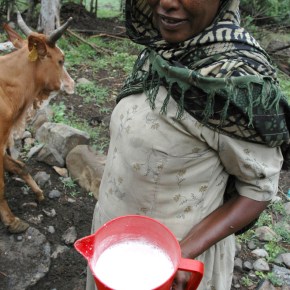
Ethiopian farmer with fresh milk from her cow (photo credit: ILRI/Apollo Habtamu). This article is written by ILRI scientists Dawit Gizachew, Barbara Szonyi, Azage Tegegne, Jean Hanson and Delia Grace Editor’s note: A statement in the article below, comparing various levels of risk, offended some of our readers. We thank those readers who let us … Continue reading
Fighting fire with fire: New study shows co-parasitic infections of cattle protect the animals from lethal disease
A Boran calf and girl in eastern Kenya (photo credit: ILRI/Stevie Mann). A new study of the cattle killer East Coast fever finds a protective process that may also be at work in human malaria: Infections with milder parasites may protect against severe disease. African cattle infected with a lethal parasite that kills one million … Continue reading
New map: Benefits of controlling trypanosomosis in the Horn of Africa
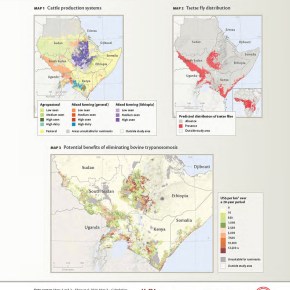
Using the Horn of Africa as an example, the maps illustrate different steps in a methodology developed to estimate and map the economic benefits to livestock keepers of controlling a disease (Shaw et al. 2014). Cattle are first assigned to different production systems as shown in Map 1, illustrating for example, where mixed farming is heavily dependent on the use of draft oxen in Ethiopia, areas of Sudan and South Sudan where oxen use is much lower, and the strictly pastoral areas of Somalia and Kenya. Continue reading
Assessing societal changes from changing dairy value chains in Sahelian pastoral communities
ILRI’s Jo Cadilhon introduces a method being tried out in Senegal to measure the social impacts of dairy supply chain innovation in pastoralist societies.
Continue reading