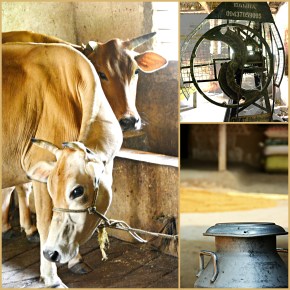
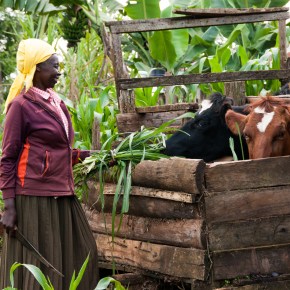
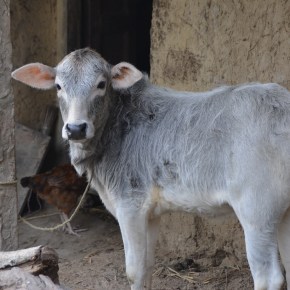
Michael Blümmel, deputy program leader for the Feed and Forage Development program at ILRI, is lead author on a new paper that explores the big benefits of treating cereal straws and stovers—the ‘residues’ of cereal crops after their grain has been harvested—to release their sugars, thereby turning these crop residues into nourishing feed for ruminant farm animals—cows, water buffaloes, goats and sheep. Continue reading
Category Archives: Fodder
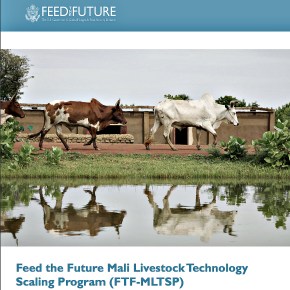
Scaling up use of livestock technologies in Mali—progress of a Feed the Future program
The most recent progress report from the Feed the Future Mali Livestock Technology Scaling Program describes some successes and swift progress made in recent months towards achieving these goals as well as some new challenges the program is facing. Continue reading
Closer, smarter integration of crops, animals and soils has bolstered food security, livelihoods and incomes in rural Zimbabwe
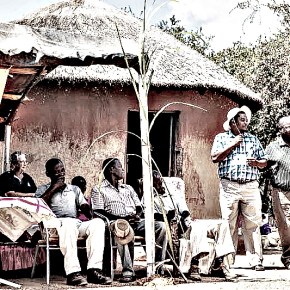
Partners and funders of a research-for-development project in rural Zimbabwe called ‘ZimCLIFS’ yesterday (18 Sep 2017) convened in the capital, Harare, to take stock of how small-scale mixed crop-and-livestock farmers improved their food and nutritional security and their livelihoods in four main districts (Goromonzi, Murewa, Gwanda and Nkayi, from 2012 to 2017) and in two spillover districts (Mutoko and Uzumba, from 2015 to 2017). Continue reading
Lifetime performance of West African dwarf goats under different feeding systems
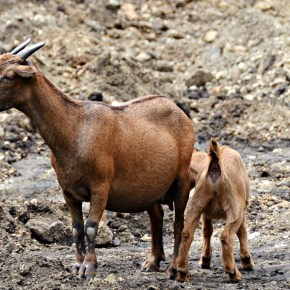
An article in ‘Animal’ compares the lifetime performance (mortality, maturity, nutrition, birth weight etc.) of West African Dwarf goats kept under various feeding systems. Continue reading
India’s Odisha State and ILRI join forces to improve livestock feeding and mechanization
A three-year ILRI-Odisha State project, ‘Feed and Fodder Production in Different Agro-Climatic Zones and its Utilization for Livestock of Odisha,’ which is worth more than USD2 million (INR18.08 crore), will map feed and fodder supply and demand, improve feeding practices and build capacity of key players in the feed value chain in the state. Continue reading
Livestock for food security and nutrition—Committee on World Food Security policy recommendations
The following policy recommendations build on the main findings of the CFS High Level Panel of Expert’s Jul 2016 report #10, on Sustainable agricultural development for food security and nutrition: What roles for livestock? The sustainable development of agriculture, including livestock, is essential for poverty reduction and the achievement of food security and nutrition. Continue reading
A first look at ILRI’s new research programs: Feed and Forage Development
A first look at a revamped ILRI research program: Feed and Forage Development Continue reading
Odisha Odyssey: A look at the emerging commercial dairy value chains in eastern India
In recent years, ILRI scientists have been working with institutional partners and local farmer organizations in Odisha, a large eastern state of India on the Bay of Bengal, on research to improve the feed and fodder resources readily available to smallholder livestock keepers. ILRI conducted this collaborative research through a collaborative CGIAR Cereal Systems Initiative for South Asia (CSISA) aiming to increase and sustain small farm productivity in selected regions of Bangladesh, India and Nepal.
As part of an ILRI photojournalism trip to India undertaken in early Mar 2016, the authors visited a town on the outskirts of Bhadrak, a city in northern Odisha, to capture a bit of what the ILRI-led CSISA work has accomplished for small-scale dairy farmers in the area. Continue reading
No longer business as usual: Improved feeds transforming dairying in Zimbabwe
Farmers participating in the Zimbabwe Crop-Livestock Integration for Food Security (ZimCLIFS) project have increased their gross margins by up to 70%. The ongoing food security improvement project is targeting the country’s dairy farmers to help improve feed farming and overall dairy production. Continue reading
Roots, tubers and banana plants: Next-generation pig feeds for Uganda
The authors call for further exploration of strategies to conserve root, tuber and banana crop residues during the harvest period to reduce waste and improve incomes for smallholder pig farmers in Uganda. Continue reading